On this page
France: Triman and Info-tri, while a Union case is pending
France requires the Triman signalétique and accompanying sorting information on household products and packaging covered by extended producer responsibility, with a statutory exclusion for household glass drinks packaging. The rules remain in force while Commission v France (C-249/26) is pending. The PPWR harmonised label is not yet the operative French mark. A pack can be required to carry Triman and Info-tri and simultaneously be forbidden from carrying environmental wording that would be routine in another market.
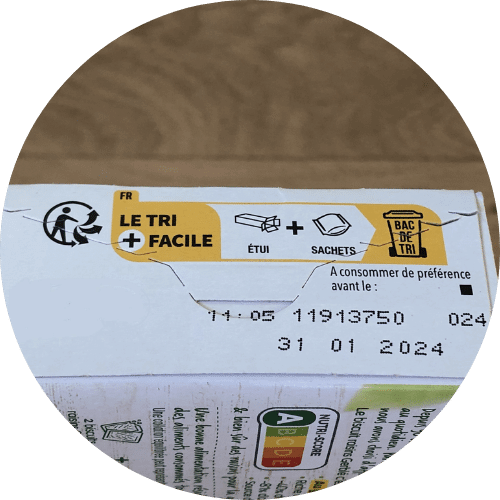
Marks are shown for identification, research and commentary. The current approved Citeo graphic kit, not a photograph, is the scheme file.
The question this report answers
France is the Member State in which a general consumer sorting label is already law, already on the pack, and already before the Court of Justice. Article L.541-9-3 of the Environmental Code requires every household product placed on the market that is subject to extended producer responsibility under L.541-10 I — excluding household glass drinks packaging — to bear a signalétique informing the consumer that sorting rules apply, together with information specifying the sorting or take-back method. Where components follow different routes, the information is given element by element. Decree No. 2021-835 of 29 June 2021 inserted the regulatory articles that define the Triman pictogram, the accompanying information, the abutment rule and the surface-area dematerialisation thresholds. For household packaging the approved implementation is Citeo’s Info-tri.
The mark is not a recyclability claim, not an EPR-membership badge and not a Green Dot substitute. Separately, L.541-9-1 prohibits specified environmental wording, including “biodégradable” and “respectueux de l’environnement”. The European Commission referred France to the Court of Justice in Case C-249/26; the action was brought on 26 March 2026 and remains pending. A pending case does not suspend the French duty. Regulation (EU) 2025/40 will later replace national sorting marks with a harmonised Union label. That label is not yet applicable. Commission Notice C/2026/3084 is Commission interpretation of the later transition. It is not a licence to remove Triman today.
Legal status at a glance
| Requirement | Status | What it is |
|---|---|---|
| Triman signalétique | mandatory | Covered household EPR products and packaging must show the annex pictogram — a figure with three arrows inside a circular arrow — informing the consumer that a sorting rule applies. |
| Info-tri / modalités de tri | mandatory | Component-level destination, placed against Triman. For household packaging, the current Citeo-approved panel is the implementation. |
| Household glass drinks packaging | statutory exclusion | L.541-9-3 excludes emballages ménagers de boissons en verre from the duty. |
| Surface-area dematerialisation | conditional | Largest side below 10 cm²: Triman and information may be digital if no accompanying document. Between 10 and 20 cm²: Triman remains physical; information may be digital. |
| Banned environmental wording | restricted | L.541-9-1 prohibits “biodégradable”, “respectueux de l’environnement” and equivalent mentions. Industrial-only compostable plastic may not bear “compostable”; home or industrial compostable plastic must bear “Ne pas jeter dans la nature”. |
| Green Dot / Point vert | not required | A private trademark. Not a French sorting instruction. From 12 February 2027 PPWR Article 12(9) confines EPR identification to a digital carrier. |
| Commission v France, C-249/26 | pending | Action brought 26 March 2026 (OJ C/2026/2510, 11 May 2026). No judgment as of verification. French rules continue to apply. |
| PPWR harmonised material label | adopted; not yet applied | Article 12(1) applies from 12 August 2028 or 24 months after the relevant implementing act, whichever is later. No Article 12 implementing act was located on EUR-Lex as of 21 August 2026. |
What the Code and the decree actually require
L.541-9-3, as reproduced by the Conseil d’État in decision n° 456081 of 21 April 2023 (which upheld Decree 2021-835), requires the signalétique on the product, its packaging or, failing that, the accompanying documents, and requires the information to be available online in dematerialised form. The eco-organism responsible for the signalétique must move household-packaging information toward a uniform presentation once more than 50 per cent of the population is covered by a harmonised collection arrangement. That is the legal basis for Info-tri’s “bac de tri” simplification.
R.541-12-17 defines Triman as the annex pictogram. R.541-12-18 and R.541-12-19 define the sorting information according to whether the producer uses an accredited eco-organism or an individual system. R.541-12-21 requires the signalétique and the information to be accolées — placed against each other. Citeo’s operational specification places Triman to the left of the Info-tri block and does not permit the pictogram to be dropped. Citeo’s graphic kit sets a 10 mm standard Triman and a 6 mm compact version, following the ADEME origin charter. An “FR” tab is required where the same pack is also sold outside France. The consumer-facing words are in French.
Info-tri lists every component that the consumer separates at use, joined by “+”, and names the stream rather than a recycling outcome. After simplification of the geste de tri, non-glass household packaging is directed to the sorting bin; glass is directed to the glass bank. Citeo does not use the word “Recycle” on the panel, because some sorted packaging is not recycled. The current approved file for the exact configuration is the scheme implementation. A competitor’s panel or a photograph is not that file.
R.541-12-20 permits, in a narrow case, replacement of Triman and Info-tri by another mandatory common signalétique of the Union or of another Member State that informs the consumer that sorting rules apply and has the same characteristics. That valve is not a general licence to omit Triman on imported household EPR products.
Size, digital delivery, and what falls outside the duty
R.541-12-21, fourth paragraph, states that where the largest side of the product or packaging is below 10 cm² and no other document is supplied, both the signalétique and the information may appear on a dematerialised medium. Between 10 and 20 cm², only the information may be dematerialised; Triman remains physical. The thresholds alter the permitted delivery method. They do not remove the obligation. Citeo’s April 2022 reading treats the test as the largest side or the total surface, and treats electronic availability as a condition of the exemption. A later Citeo note anticipated a decree adjusting the test for cylindrical and spherical packs. No such amending decree was located on Legifrance as of verification.
The duty applies to household products subject to EPR. Non-household industrial and commercial packaging is outside L.541-9-3. Household glass drinks packaging is excluded by the statute itself. Multipacks, removable components, imported stickers and dual-market packs require a component-by-component reading of the current Citeo kit and of the largest-surface rule. Administrative penalties for breach of the information duties in L.541-9-2 and L.541-9-3 are set by L.541-9-4: an administrative fine not exceeding €3,000 for a natural person and €15,000 for a legal person, imposed under the consumer-code procedure.
Who the obligation follows
The obligation follows the person placing the covered household product on the French market under the relevant EPR stream. Depending on the supply chain that person may be a French manufacturer, an importer, or another market placer. Eco-organisms — Citeo, Adelphe and Léko for packaging — design and approve Info-tri. They do not absorb the producer’s duty to affix the correct panel. Contractual allocation of design production does not transfer the public-law obligation. Misleading claims may attract separate consumer-law sanctions. Enforcement can involve the environmental authorities, the consumer-protection authorities and the relevant EPR scheme.
Banned wording, and Commission v France
L.541-9-1, inserted by the AGEC law and in force for the mentions ban from 1 January 2022, is a different instrument from the sorting mark. Plastic products or packaging compostable only in industrial units may not bear “compostable”. Those compostable in home or industrial composting must bear “Ne pas jeter dans la nature”. “Biodégradable”, “respectueux de l’environnement” and equivalent mentions are prohibited on products and packaging. A pack can therefore be required to carry Triman and Info-tri and simultaneously be forbidden from carrying a green claim that would be routine in another market.
Case C-249/26, European Commission v French Republic, was brought on 26 March 2026 and published in the Official Journal on 11 May 2026 (C/2026/2510). The Commission alleges that the Triman-plus-sorting-information duty on household EPR products, with only a limited dematerialised exception, restricts free movement of goods under Article 34 TFEU, and that AGEC Article 17 was not notified under the Single Market Transparency Directive. The pre-litigation history includes a letter of formal notice of 15 February 2023, a reasoned opinion in November 2024 and a decision to refer of 17 July 2025. Until the Court rules or the legislature repeals the provisions, French operators remain subject to L.541-9-3. A pending reference is not a stay.
What the Union regulation does not yet replace
Decree 2021-835 applied from 1 January 2022. Citeo’s operational cut-off for previous household-packaging markings was 9 March 2023. Regulation (EU) 2025/40 applies generally from 12 August 2026. Its harmonised material-composition label under Article 12(1) applies from 12 August 2028 or 24 months after the relevant implementing act enters into force, whichever is later. Reusable-packaging labelling under Article 12(2) follows 12 February 2029 or 30 months after the implementing act. Decision 97/129/EC is repealed from 12 August 2028 (Article 70(2)). From 12 February 2027, Article 12(9) confines identification of EPR participation to a digital carrier. The Green Dot was never a French sorting instruction; that digital-carrier rule is about EPR identification, not about Triman.
Commission Notice C/2026/3084 of 10 June 2026 states that Member States will not be allowed to keep national sorting labels beside the Union label after the Article 12 trigger, and that national measures should be repealed or adapted before that date. No Article 12 implementing act was located on EUR-Lex as of 21 August 2026. The Notice is Commission interpretation. It is not a substitute for a judgment in C-249/26, and it is not a licence to remove Triman today.
Primary sources and verification
France. Environmental Code, Article L.541-9-3. Legifrance
France. Environmental Code, Article L.541-9-1 (banned mentions). Legifrance
France. Environmental Code, Article L.541-9-4 (penalties). Legifrance
France. Decree No. 2021-835 of 29 June 2021. JORF
Conseil d’État. Decision n° 456081, 21 April 2023 (upholding the decree; reproduces L.541-9-3 and R.541-12-21). Decision
Citeo. Info-tri graphic kit and guidance. Citeo
Court of Justice of the European Union. Case C-249/26, Commission v France, OJ C/2026/2510. OJ notice
European Union. Regulation (EU) 2025/40 (PPWR), Articles 12, 70 and 71. EUR-Lex
European Commission. Notice C/2026/3084 of 10 June 2026 on PPWR labelling. EUR-Lex
French-language legislation and the current approved scheme files control. Last verified: 21 August 2026.