On this page
South Korea: a Korean discharge mark, not a US resin triangle
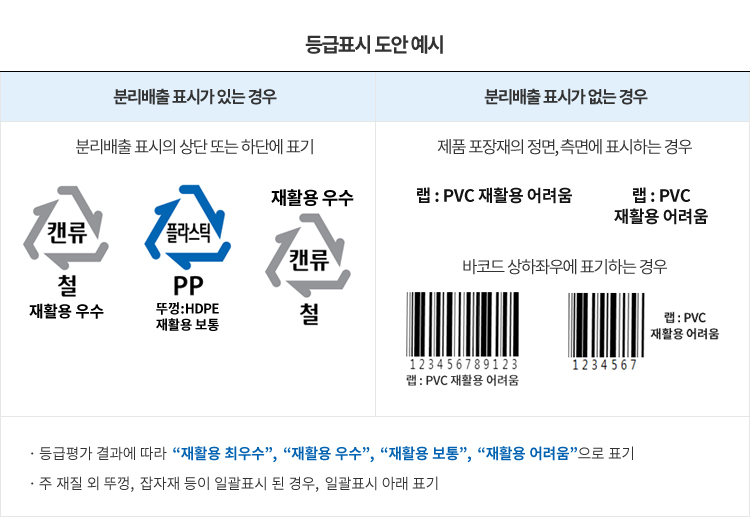
Article 14 of the Act on the Promotion of Saving and Recycling of Resources requires a separate-discharge mark on designated products and packing materials in accordance with the Minister’s notified designs. Recyclability grading is a second duty: the “difficult to recycle” grade must appear on the pack. Foreign resin-identification codes are not a substitute. KECO’s restatement was last modified on 1 June 2026.
Marks are shown for identification, research and commentary. Use the current 고시 designs; recommended colours follow separate-collection bin colours but contrast is required.
The question this report answers
Article 14 requires a manufacturer, importer or seller of products and packing materials prescribed by Presidential Decree to put a separate-discharge mark in accordance with guidelines determined and publicly notified by the Minister. KECO’s page, last modified 1 June 2026, still cites Article 14, Decree Articles 16 and 18, and the Guideline (KECO cites 고시 제2022-254호; design families published from the 2021-140 revision remain the operational artwork). The mark is a Korean category word inside a prescribed symbol, plus a material code such as PET, HDPE, PP or OTHER. Horizontal and vertical minimum size is 8 mm excluding the material-name letters. Failure to place the mark, or placing a false mark, is an administrative fine not exceeding 3 million won (Article 41(2)4).
A second regime, Articles 9-2 and 9-4, requires producers with recycling obligations to undergo evaluation of packing-material quality and structure and to indicate the results. Grades run 최우수 / 우수 / 보통 / 어려움. The “difficult to recycle” (재활용 어려움) grade is mandatory on the exterior. Average or better grades are optional. Evaluation is submitted to KECO through iepr.or.kr. PET/HDPE letters may appear inside the Korean mark as 표시재질. They are not a substitute for it. English “plastic” or “OTHER” does not satisfy the Korean category word.
Legal status at a glance
| Requirement | Status | What it is |
|---|---|---|
| Separate-discharge mark | mandatory | Korean 도안 on designated paper cartons, metal cans, glass (other than deposit bottles), synthetic-resin packaging, film/sheet, foam and single-use bags. |
| “Difficult to recycle” grade | mandatory if graded 어려움 | On the exterior, above, below or beside the separate-discharge mark. Optional if the grade is average or better. |
| SPI / chasing-arrows RIC | does not satisfy | PET/HDPE/… letters may appear inside the Korean mark as 표시재질. They are not a substitute for it. |
| Empty-container deposit bottles | exempt from Art. 14 | Article 15-2; Guideline Article 6. Separate resource-circulation deposit marks apply. |
Design, placement and the exemptions that actually exist
Category words include 무색페트, 플라스틱, 비닐류, 캔류, 종이, 일반팩, 멸균팩, 유리 and 종량제배출. KECO: rigid containers and trays are labelled 플라스틱; film and sheet are labelled 비닐류. OTHER covers unlisted single resins, multi-resin composites, PET-G, and separable mixes of synthetic resin with other materials (paper only if synthetic resin is attached on both sides). If printed in colour, recommended colours follow the ministerial separate-collection instruction (for example yellow for colourless PET, blue for plastic, purple for film). Contrast with the pack remains necessary.
Placement (Guideline Article 4): front, side, or immediately around the barcode. If those positions are impossible: bottom or lid. Each separable component. Inseparable multi-packs, or where per-component marking is structurally difficult: one grouped mark on a principal part. The reverse panel is not a free choice when front, side or barcode positions are available.
Exemptions in Guideline Article 6, as restated by KECO on 1 June 2026: deposit bottles; unprinted film/sheet with no printing, engraving or label of any kind; surface area below 50 cm² (containers/trays) or 100 cm² (film); contents 30 ml or 30 g or less; structurally impossible to print, engrave or label; wrap film thinner than 20 µm; packaging the obligated producer recovers directly without passing through general consumers; and limited omission of component names where food-labelling law already requires a synthetic-resin declaration. Any print on a film, including a tiny brand, destroys the unprinted-film exemption. Pull the live 고시 제2022-254호 from law.go.kr before locking Korean artwork, in case KECO’s restatement and the 2021-140 PDF diverge.
Recyclability grading as a second duty
Article 9-4 requires evaluation and indication of results. False or missing indication: Article 41(2)2-3, fine not exceeding 3 million won. The “difficult” indication sits with the separate-discharge mark; if two or more such marks exist, the grade need appear with only one of them. If there is no separate-discharge mark, the grade goes on the front, side or with the material indication. PVC/PVDC film or sheet that is exempt from the separate-discharge mark may still need the “difficult” indication. A 어려움 grade is not a recycling logo for export markets.
Article 14 obligors are manufacturers, importers or sellers of Decree Article 16 items. Article 9-4 obligors are producers obligated to recycle under Article 16(1) — an overlapping but not identical set. The competent ministry was reorganised as the Ministry of Climate, Energy and Environment; that is organisational, not a new mark system. A digital carrier is not a substitute for the on-pack discharge mark. Korean-language 고시 text controls.
Primary sources and verification
Korea Legislation Research Institute. Act on the Promotion of Saving and Recycling of Resources (English). KLRI
Korea. Separate-discharge marking guideline. law.go.kr
Korea. Recyclability-grade labelling standard. law.go.kr
KECO. Separate-discharge marking. KECO
KECO. Evaluation portal. iepr.or.kr
Korean-language 고시 text controls. Last verified: 21 August 2026.