On this page
United Kingdom: RAM off-pack, OPRL voluntary, a deposit logo in 2027
The United Kingdom does not currently require a universal recycling label on ordinary packaging. Large producers must assess and report the recyclability of household packaging, but that duty does not require a mark on the pack. OPRL remains a voluntary membership scheme. A previously proposed statutory Recycle / Do Not Recycle label was not included in the 2024 regulations. Covered deposit containers will require a scheme label from 1 October 2027.
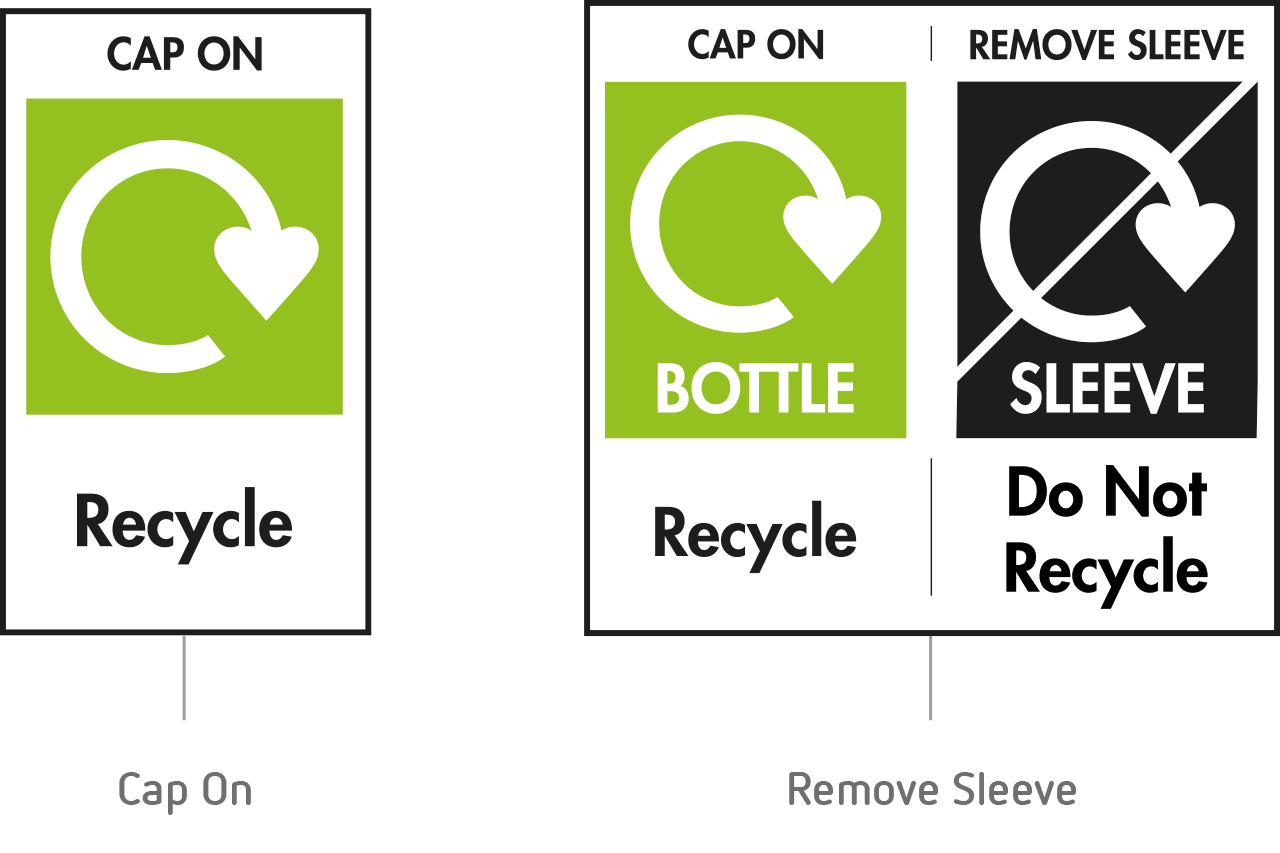
Marks are shown for identification, research and commentary. OPRL artwork is licensed. The statutory deposit-return logo is a separate, later duty.
The question this report answers
The Producer Responsibility Obligations (Packaging and Packaging Waste) Regulations 2024 (SI 2024/1332) require liable producers to assess specified household packaging in accordance with the Recyclability Assessment Methodology, keep records, report the results and pay disposal fees that are modulated by, among other things, recyclability. Regulations 25(3), 26, 37 and 64 create that architecture. None of them requires the assessment result to be printed on the pack. A 2023 government response had described a mandatory Recycle / Do Not Recycle label as part of packaging EPR; the 2024 instrument omitted it. UK administrations later paused statutory labelling pending work with the EU. Defra has said that once there is greater certainty about the Union approach it will consider options. That is a policy statement, not a date.
OPRL Ltd remains a private membership scheme using the Recycle Now ident under licence from WRAP. A green or amber RAM output will often correspond to “Recycle” under OPRL’s October 2025 mapping, and a red output to “Do Not Recycle”, with published exceptions. Correspondence is not identity: OPRL membership does not discharge RAM, and a RAM rating does not authorise a consumer claim. Environmental wording on packs is policed under the Digital Markets, Competition and Consumers Act 2024 from 6 April 2025, with the CMA Green Claims Code as the Commission’s published view.
Legal status at a glance
| Requirement | Status | What it is |
|---|---|---|
| RAM assessment and reporting | mandatory; off-pack | Liable (large) producers. RAG-rate specified household packaging. First report due 1 October 2025 for January–June 2025. Fees modulated from the 2026 assessment year. |
| Statutory Recycle / Do Not Recycle label | not enacted | Absent from SI 2024/1332. Previously indicated for about 1 April 2027; paused. Not current law. |
| OPRL | voluntary | Recycle where ≥75% of UK local authorities collect the type and it is sorted, reprocessed and sold; Do Not Recycle below 50% or where not effectively recycled; “Check Home Collections” for a residual 50–75% set. |
| DRS logo and return code (England, NI, Scotland) | adopted; live 1 Oct 2027 | SI 2025/67 regs 24 and 55–57; SSI 2025/188. In-scope PET, steel and aluminium, 150 ml–3 L. Glass out. Exchange for Change is the DMO. |
| DRS (Wales), including glass | adopted; glass transition | WSI 2026/103. Scheme 1 October 2027. Glass labelling disapplied and deposit 0 pence until 30 September 2031. |
| Environmental claims | mandatory | DMCC Act 2024 ss 226–227; CMA Green Claims Code. Monetary penalty up to £300,000 or 10% of turnover (s. 182). |
RAM is not an on-pack duty
A “liable producer” for Part 5 is a large producer: turnover above £2 million and packaging supplied above 50 tonnes, on the regulation 24 tests. Small producers (above £1 million and 25 tonnes) register and report quantities; they do not carry the RAM duty. Regulation 25(5) takes specified household packaging that is exempt, and drink containers of any material other than glass (subject to regulation 136(2)), out of the assessment — in-scope DRS PET, steel and aluminium drinks containers are not RAM-assessed. The method is the scheme administrator’s methodology under Schedule 7 paragraph 7, published on GOV.UK as a red / amber / green (plus medical variants) assessment against current UK infrastructure for eight material categories. Treating a green RAM rating as permission to print “Recycle” is the principal UK trap. RAM never authorises a consumer instruction. The CMA still applies to the overall impression of the pack.
OPRL as a private mapping, not a statute
For members, “Recycle” requires collection by 75 per cent or more of UK local authorities through household recycling and effective sortation, reprocessing and sale as recyclate. “Do Not Recycle” applies below 50 per cent collection or where the material is not effectively recycled. A limited set of fully recyclable formats at 50–75 per cent collection retain “Check Home Collections”. Specialist routes, multi-component labels, refill instructions, B2B labels and calls to action (“Cap On”, “Rinse”, “Empty”, “Scrunch”) are part of the catalogue. OPRL’s public design guidance sets a 6-point minimum for the component name and instruction. An optional “UK only” message is available because the evidence base is United Kingdom infrastructure. OPRL stated on 1 October 2025 that it did not require existing artwork to be changed solely because of the RAM mapping update; new artwork uses the current tool. A private transition allowance does not protect artwork that has become materially false under consumer law. Qualifying liquid cartons could move to “Recycle” from 1 April 2026 on collection-coverage grounds; that change is a scheme designation, not a statute. Omitting OPRL is not a pEPR offence.
Deposit return — four statutes, one go-live date
England and Northern Ireland: SI 2025/67 comes into force, with specified set-up exceptions, on 1 October 2027. Regulation 24 prohibits supply of a deposit item unless it carries the required item logo and a scheme return code. Regulation 55 requires the deposit management organisation to issue a single scheme logo; regulation 57 defines the return code as a scannable identifier of the registered scheme producer. Exchange for Change’s Scheme Logo Regulatory Requirements (Version 1.0-260130) specify a language-independent bottle/can/coin icon, one logo per item, primary (portrait) as default, secondary (landscape) only where space prevents the primary being applied clearly, 1 mm clear space, and preferred black or white. Exact millimetre lock-ups are in that PDF. Glass is not in scope for England, NI or Scotland. Scotland’s 2020 regulations, as amended by SSI 2025/188 regulation 3, substitute 1 October 2027 for 1 October 2025 and align materials; Exchange for Change is designated to run Scotland as well.
Wales: WSI 2026/103 brings the scheme into force on 1 October 2027 and includes glass. Regulation 3 creates a glass transitional period to 30 September 2031 during which glass deposit items need not comply with labelling (regulation 25 disapplied) and the glass deposit is 0 pence. The design is interoperability for PET and metal without forcing dual-labelled glass SKUs during transition. As of the Commons Library briefing of 22 July 2026 Wales had not yet appointed its DMO. OPRL remains optional on DRS items; the statutory logo cannot be omitted because an OPRL label is present. DRS PET, steel and aluminium drinks are outside RAM (regulation 25(5)); they are not outside claims law.
Claims law that already applies
The CMA Green Claims Code (20 September 2021) sets six principles: truthful, clear, not hiding material information, fair comparisons, full life cycle, substantiated. A bare “recyclable” that does not say whether it is the product or the pack is likely to mislead; recycling symbols on formats that current UK infrastructure does not recycle are called out. From 6 April 2025 the Code sits under DMCC Act 2024 Part 4 Chapter 1 rather than CPUTR. CMA’s January 2026 supply-chain note confirms that “making” a claim includes pack wording, green logos and omissions, and that retailers can be liable for repeating a manufacturer’s pack claim. Direct CMA enforcement includes directions, redress and monetary penalties up to £300,000 or 10 per cent of turnover. RAM files, OPRL files and DRS files are therefore different legal objects. A RAM colour is not a pack mark.
Primary sources and verification
United Kingdom. SI 2024/1332, especially regulations 25, 26, 37 and 64. legislation.gov.uk
Defra / PackUK. Recyclability Assessment Methodology. GOV.UK
United Kingdom. SI 2025/67 (England and NI DRS), regulations 1, 24, 55–57. legislation.gov.uk
Scotland. SSI 2025/188, regulation 3. legislation.gov.uk
Wales. WSI 2026/103, regulations 1 and 3. legislation.gov.uk
Exchange for Change. Scheme Logo Regulatory Requirements, v1.0-260130. PDF
OPRL. How the scheme works. OPRL
CMA. Green Claims Code. GOV.UK
United Kingdom. DMCC Act 2024, section 182. legislation.gov.uk
UK and devolved legislation control. Last verified: 21 August 2026.