On this page
United States: no federal recycling mark, and a claims regime that already applies
Federal law does not require a recycling or sorting mark on ordinary packaging. The operative federal constraint is the prohibition of unfair or deceptive claims. The Green Guides tell marketers how the Commission currently views recyclable, compostable, degradable, recycled-content and seal claims. State statutes — not this report — require resin codes, California redemption statements and related marks. How2Recycle is a voluntary licensed scheme. Pending federal bills are not law.

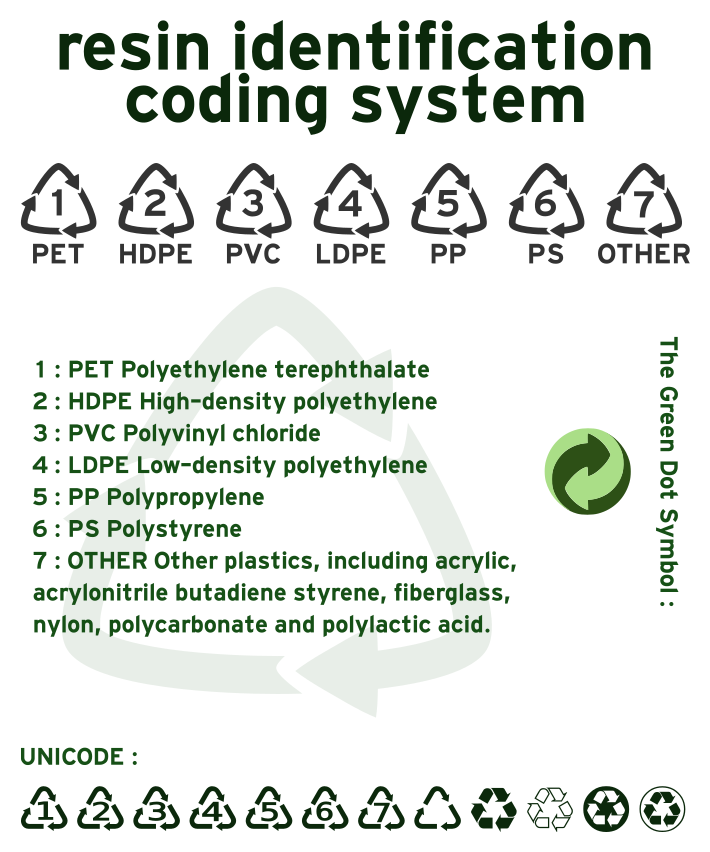
Marks are shown for identification, research and commentary. How2Recycle artwork is licensed. Resin-code placement is a state-plus-FTC problem, not a federal print duty.
The question this report answers
16 CFR 260.1(a) states that the Green Guides set forth the Commission’s current views about environmental claims, do not confer rights, and do not bind the FTC or the public. The Commission can take action under the FTC Act if a marketer makes an environmental claim inconsistent with the guides, and in that action it must still prove unfairness or deception under section 5. The Guides were last revised in 2012. A review opened in December 2022 (87 Fed. Reg. 77766) with a recyclable-claims workshop on 23 May 2023; no 2024–2026 revision has been issued. eCFR Title 16 current to 19 August 2026 leaves Part 260 substantively the 2012 text.
There is no federal statute that says “apply this recycling pictogram.” How2Recycle is a Sustainable Packaging Coalition / GreenBlue licensed label (Widely Recyclable, Check Locally, Not Yet Recycled, Store Drop-Off). USDA Certified Biobased Product (7 CFR Part 4270) communicates biobased content, not recyclability. Break Free From Plastic Pollution Act of 2023 (S. 3127 / H.R. 6053, 118th Congress) was not enacted. The Recycling and Composting Accountability Act (H.R. 4109, 119th Congress) remained introduced, not enacted, after subcommittee forwarding on 14 May 2026; it is an EPA study bill, not an on-pack mandate. How2Recycle membership does not displace FTC Act §5. A nationwide SKU still needs a state matrix.
Legal status at a glance
| Requirement | Status | What it is |
|---|---|---|
| Federal recycling / sorting mark | none | No federal print duty on ordinary packaging. |
| Green Guides / FTC Act §5 | claims law | Guides are not independently binding; ignoring them is how §5 cases are built. Apply to words, symbols, logos, brand names and B2B. |
| How2Recycle | voluntary | Licensed. Not a substitute for substantiation. |
| Resin identification code | state law; federal claim risk | Inconspicuous bottom RIC is not, federally, a recyclable claim. Front-of-pack RIC in chasing arrows is. Many states require the code itself — see the state reports. |
| Federal packaging bills | not enacted | S. 3127 died with the 118th Congress. H.R. 4109 is not law. |
What the Guides actually say about packs
Recyclable (§ 260.12). Do not market as recyclable unless the item can be collected, separated or otherwise recovered through an established recycling programme for reuse or use in manufacturing another item. Unqualified claims only if recycling facilities are available to a substantial majority of consumers or communities where the item is sold; “substantial majority” means at least 60 per cent. Below 60 per cent, qualify. Unqualified claims only if the entire product or package, excluding minor incidentals, is recyclable. If any component significantly limits recyclability, or if shape, size or an attribute causes programmes to reject the item, a recyclable claim is deceptive. Example 2: a nationally marketed yogurt container with the RIC (arrows in a triangle, number, abbreviation) on the front label near the name is a recyclable claim and must be qualified unless the 60 per cent test is met; the same RIC embedded inconspicuously on the bottom is not a recyclable claim. Footnote 49: the RIC is now ASTM D7611.
Compostable (§ 260.7). Competent and reliable scientific evidence that all materials break down into usable compost in a safe and timely manner in an appropriate facility or home compost. Qualify if not home-compostable, or if facilities are not available to a substantial majority. Degradable (§ 260.8). Unqualified “degradable / biodegradable / oxo- / photo-” claims require complete breakdown in a reasonably short period after customary disposal. Unqualified claims are deceptive if the item does not completely decompose within one year after customary disposal, and are deceptive for items customarily going to landfills, incinerators or recycling facilities because those locations do not present one-year complete decomposition. Recycled content (§ 260.13). Materials recovered or diverted from the waste stream. Unqualified “recycled content” only if the entire product or package (minus minor incidentals) is recycled; otherwise qualify the percentage by weight. Seals (§ 260.6). Third-party name, logo or seal is an endorsement (Part 255). Certification does not remove the marketer’s substantiation duty. A seal that does not convey its basis likely communicates a general environmental benefit (§ 260.4), which is almost never substantiable.
What this federal report does not replace
Rigid-plastic resin codes, California “CA Redemption Value” wording, SB 343 recyclability criteria and the July 2026 injunction, compostable-presentation statutes, non-flushable-wipe marks and state EPR programmes are state law. They are documented in the fifty state reports and in the Theme 2 articles on SB 343, SB 54, compostable labelling and resin codes. This page is the federal overlay: no federal mark, claims substantiation everywhere, How2Recycle optional, bills unenacted. Applying one state’s RIC geometry nationwide is not a federal solution. Catalogue Break Free or H.R. 4109 as current labelling law is the error this report is written to prevent.
Primary sources and verification
United States. 16 CFR Part 260 (current). eCFR
United States. 16 CFR 260.12 (recyclable claims). Cornell LII
United States. 16 CFR 260.7, 260.8, 260.13, 260.6. § 260.7
United States. FTC Act §5, 15 U.S.C. §45. Cornell LII
FTC. Green Guides page. FTC
How2Recycle. About the label. how2recycle.info
Congress. S. 3127, 118th Congress. congress.gov
Congress. H.R. 4109, 119th Congress. congress.gov
USDA. 7 CFR Part 4270 (BioPreferred). eCFR
Federal instruments on this page; state marks in the fifty state reports. Last verified: 21 August 2026.