On this page
Carbon labels and eco-scores: what do the performance marks actually measure?

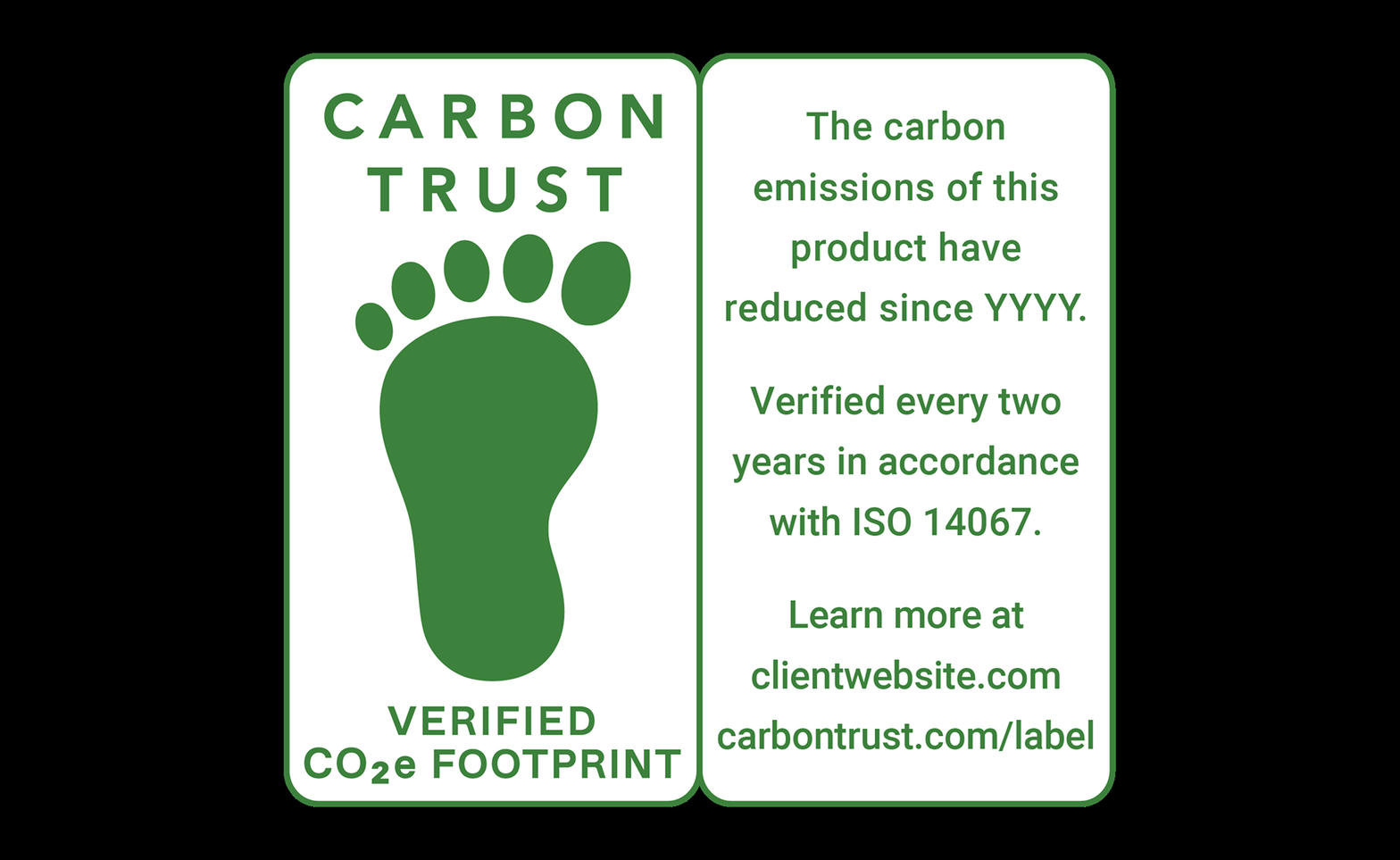
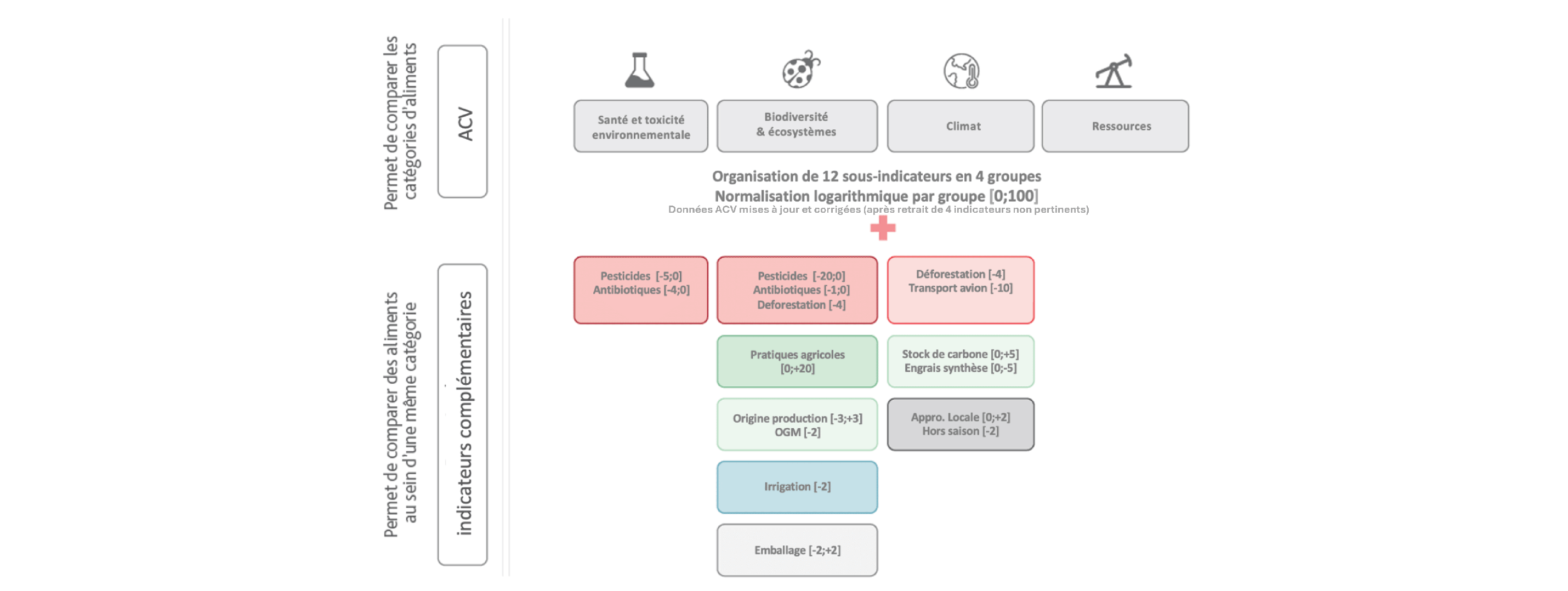
Marks and reference graphics are shown for identification, academic research and commentary. The image does not grant permission to apply a scheme mark to packaging; consult the issuing body's current eligibility and artwork rules.
The performance family
The other marks in this section are mostly binary: certified or not, recyclable or not, member or not. The performance family grades. Carbon-footprint labels, letter scores and multi-criteria eco-scores assert magnitude: a product’s measured impact on a scale, often relative to other products.
The carbon labels
The Carbon Trust's product labels constitute the reference case for single-issue carbon labeling. The UK organisation's current label family covers verified footprint measurement and reduction claims, comprising labels that assert measured emissions reductions, commitments aligned to reduction pathways, and comparative variants. The portfolio was restructured by subtraction: from September 2023 the Carbon Trust ceased offering its carbon neutral product verification, replacing the neutrality claim with measurement- and reduction-focused labels (Carbon Trust, 2023). The withdrawal of "carbon neutral" verification by that organisation coincided with a broader change in the claim family's position, since neutrality claims rest on offsetting, and offsetting-based product claims were by then the subject of convergent challenge from researchers, from claims regulators, and from the EU legislation described below, which blacklists claims that a product has a neutral, reduced or positive climate impact based on offsetting (Directive (EU) 2024/825). In the United States, the FTC's Green Guides address the underlying accounting: carbon offset claims must reflect appropriate quantification, must not double-count, and must disclose whether claimed reductions will not occur for two years or more (16 CFR § 260.5).
What a verified carbon label asserts is a measured, audited footprint or reduction against a stated methodology and boundary. What it does not assert is significance, since a footprint number presented without category context is difficult for consumers to interpret. That interpretive gap is the comprehension problem to which the graded scores respond.
The eco-scores
The graded scores translate lifecycle assessment into ordinal form, expressed as a letter, a colour or a position on a scale, and France is the principal site of their development and contestation.
The French environmental score (coût environnemental, the successor to the affichage environnemental programme) is a regulated implementation established under the climate legislation, operationalised by decree from October 2025 for textiles first, computed on the state's Ecobalyse platform from lifecycle data supplemented by non-LCA factors, and opened after a transitional year to third-party calculation and publication, such that from October 2026 scores for covered products can be computed and displayed by actors other than the brand (Anthesis, n.d.). That design makes the score a public metric rather than a marketing option, in that the French state has taken the eco-score's methodology into public administration and is extending the same approach to its distribution.
Eco-Score, the A-to-E food rating built on the public Agribalyse lifecycle database and popularised by apps and retailers, demonstrated both the format's consumer traction and its vulnerabilities: methodological contestation from producer interests, litigation over the label's naming and framing, and the critique that LCA-derived food scores under-weight biodiversity, pesticides and farming-system effects (FoodNavigator, 2023). Planet-score, developed by France's organic-farming research institute with NGO backing, represents that critique in institutional form, being a rating that supplements LCA with pesticide, biodiversity and animal-welfare dimensions and producing systematically different rankings from Eco-Score for the same products (Planet-score, n.d.). The divergence between the two scores makes the family's methodological argument visible at the point of sale, since what an environmental grade represents depends on what the grader has chosen to count.
Harmonisation attempts form a further strand. Foundation Earth, the industry-backed effort toward a unified European food eco-label, was subsequently absorbed into the EIT Food orbit, an outcome of absorption and regrouping rather than of shelf adoption (Food Manufacture, 2024). That outcome is consistent with the structural condition the French state addressed by legislation, namely that scoring requires an authority and that voluntary consortia have difficulty supplying one.
Business-to-business platforms constitute the family's professional layer: HowGood's ingredient-level impact database and Mondra's retail-facing product assessment operate scoring as supply-chain analytics, feeding retailer scorecards and reformulation decisions, with consumer display an optional endpoint (HowGood, n.d.; Mondra, n.d.). A substantial part of the eco-score economy operates at this level rather than on packaging.
The Carbon Trust's post-2023 label portfolio
The Carbon Trust's restructured label family warrants closer examination, because it indicates the form carbon claims take where a verifier incorporates legal exposure into the design of its product line.
The family's claim types, as documented across the organisation's labeling materials, differentiate along the axes claims law now addresses. Measurement claims attest a verified footprint. Reduction claims attest measured decreases achieved, or commitments aligned to defined reduction pathways, a temporal distinction between achieved and planned outcomes that offset-era labels did not consistently draw. Comparative claims attest lower footprints against specified baselines, either the trader's own portfolio or a market standard, with the specification of the baseline responding to the requirement in comparability doctrine that a comparison identify its comparator. A packaging-boundary variant confines the assertion to the packaging's own footprint and is available to manufacturers, which is a scope restriction that general product labels cannot express (Carbon Trust, n.d.).
What the family does not contain, following 2023, is the totalising claim: no label in the portfolio asserts that a product is climate-neutral, climate-positive or climate-friendly. That omission tracks the legal position, comprising the EU blacklist's prohibition on offsetting-based neutrality claims and the generic-claims regime's treatment of unqualified virtue assertions (Directive (EU) 2024/825). It also indicates the form toward which the performance family may converge, namely quantified, scoped, comparator-named claims attested by third parties, with the interpretive question of whether a given quantity is good left unclaimed. Read as a statement of doctrine, the verifier's product line anticipates a shift from verdicts to measurements, with evaluation returned to the reader.
The French regime advances the same shift from the public side, through a state-computed multi-criteria score whose third-party publication provision removes display discretion from brands (Anthesis, n.d.). Taken together, the two models indicate a division of labour within the family, in which private verifiers attest quantities, public authorities operate graded verdicts, and the self-graded middle ground is removed by legislation.
Regulatory treatment under EU law
The performance family's regulatory situation changed with the EU's Empowering Consumers Directive, applicable from September 2026, and the change is specific to this family's structure.
The directive's blacklist makes it per se unfair to display "a sustainability label that is not based on a certification scheme or not established by public authorities" (Directive (EU) 2024/825, Annex I). Graded scores are sustainability labels within the directive's meaning, and the provision therefore sorts the family into three legal classes. Scores established by public authorities, of which the French score is the leading instance, are compliant by definition and are also advantaged competitively, in that regulation removes their unregulated competitors. Scores resting on genuine third-party certification schemes, with published criteria, independent verification and complaint procedures, may qualify, subject to the scheme meeting the directive's requirements. Self-operated scores, such as a retailer's own A-to-E rating applied on its own shelves or a brand's proprietary planet-rating, are prohibited as such, irrespective of methodological quality, because the characteristic addressed is structural, namely that the grader grades itself.
The prohibition on offsetting-based neutrality claims applies concurrently to carbon claims, and the FTC's offset rules (16 CFR § 260.5) address the same territory in the United States through case-by-case deception analysis rather than through a per se rule. The family therefore enters the enforcement period subject to specific legal constraints, a position attributable to the comprehensiveness of its claims, which purport to summarise a product's environmental worth, and to the limited external checking of its self-operated variants.
Packaging within the performance frame
The performance family's significance for packaging is frequently mislocated, and locating it clarifies both the marks' reach and their limits for the subject matter examined here.
Packaging enters the scores twice, asymmetrically. As a component of product footprints, packaging is one lifecycle stage among many, and typically a minor one for food, where agricultural stages dominate the totals that the graded scores compress. The practical consequence runs contrary to common intuition: a product's eco-score is largely insensitive to its packaging choices, and packaging redesign is among the weaker levers for moving a graded label, which produces a mismatch between the scores' salience and the visibility of packaging decisions that retail sustainability communication routinely passes over. As a subject in its own right, packaging carbon is addressed by dedicated instruments: the verifier's packaging-boundary label confines measurement to the pack itself (Carbon Trust, n.d.), and business-to-business footprinting platforms carry pack-level comparisons through procurement, which is the layer at which packaging's carbon is in practice determined and which is not visible at the point of sale.
The asymmetry defines the family's relationship to the rest of this theme. The disposal, content and certification marks govern packaging's material circuit — what it is, where it came from and where it goes — on evidence native to that circuit. The performance marks import a different axis, production impact, on which the material circuit's attributes register weakly, since recyclability and recycled content produce modest footprint improvements that a reformulated recipe can exceed by a wide margin. Both axes are measurable, neither substitutes for the other, and packages increasingly carry marks from both, which invites cross-axis aggregation of the form recyclable, therefore climate-friendly or low-carbon, therefore circular that neither mark family's evidence supports. The performance family's contribution to packaging literacy is accordingly largely negative in character: it marks the boundary at which this theme's subject ends and a further measurement regime, with its own disputes, begins.
Scope and limits of the assertions
The family's semantics require particular care, because the marks' numerical precision may be taken to indicate a precision of meaning that they do not carry.
A verified carbon label asserts a measured quantity under a stated methodology, boundary and period, and asserts nothing about any other impact dimension, being silent on water, toxicity, biodiversity and circularity by construction. A graded eco-score asserts a position under a weighting scheme; if the weights change, as between an LCA-pure and a pesticide-supplemented methodology, the grade changes without the product changing, which is what the Eco-Score and Planet-score divergence demonstrates on shelf. Neither asserts comparability beyond its own scheme, so that an A in one system and a B in another share a letter rather than a meaning. Neither asserts packaging recyclability, content or disposal route, the performance family measuring production impact and saying nothing about the matters this theme's other families cover. Moreover, a score's absence asserts least of all, since coverage follows scheme adoption rather than product merit.
A further caution concerns inference. Graded marks invite transitive trust, in that a reader may assume the grade summarises what matters, weighted as the reader would weight it. Every methodological choice contained within the score — functional units, system boundaries, data vintages, and the decision to count or exclude biodiversity — is a value judgment expressed in numerical form. Interpretation of a performance mark therefore requires attention both to the grade and to the grader.
Summary
The performance marks extend labeling beyond routing waste and certifying attributes to expressing environmental impact as a consumer-facing quantity or grade. The family's record includes elaborated measurement methodologies alongside outcomes its own participants have treated as failures: neutrality claims withdrawn by their verifiers, competing scores that grade the same yoghurt differently, and harmonisation initiatives absorbed before achieving harmonisation. The family's future divides along the line the EU has drawn, between public and certified scores, with the French model as the regulated instance, and the prohibited self-graded remainder. What that division does not resolve is the family's underlying tension, namely that a single grade must compress incommensurable impacts and that every such compression is contestable. The performance mark's stated purpose is a number that settles the argument; its record to date consists of numbers that relocate it.
Relocation nonetheless has consequences that can be stated independently of whether the current instruments survive. A dispute between two published scoring methodologies, conducted in functional units and system boundaries, is checkable against those methodologies, whereas adjectival environmental marketing was contested in the register of impressions and was not falsifiable in the same way. The competing scores disagree about specified quantities. Even if the performance family's grades do not converge, its methodological infrastructure — the databases, the disclosure conventions and the practice of stating boundaries — remains available to the field, and the argument continues in published form.
References
Anthesis (n.d.) The French eco-score: regulatory overview. Available at: Open source (Accessed: 18 August 2026).
Carbon Trust (2023) What's new with our product carbon footprint labels, 26 September. Available at: Open source (Accessed: 18 August 2026).
Carbon Trust (n.d.) Product carbon footprint label. Available at: Open source (Accessed: 18 August 2026).
Directive (EU) 2024/825 of the European Parliament and of the Council of 28 February 2024, OJ L, 2024/825, 6.3.2024. Available at: Open source (Accessed: 18 August 2026).
Food Manufacture (2024) Foundation Earth joins EIT Food, 12 August. Available at: Open source (Accessed: 18 August 2026).
FoodNavigator (2023) European organic association launches lawsuit over environmental labelling, 26 January. Available at: Open source (Accessed: 18 August 2026).
HowGood (n.d.) HowGood. Available at: Open source (Accessed: 18 August 2026).
Mondra (n.d.) Mondra. Available at: Open source (Accessed: 18 August 2026).
Planet-score (n.d.) Planet-score. Available at: Open source (Accessed: 18 August 2026).
16 CFR § 260.5 (Carbon offsets). Available at: Open source (Accessed: 18 August 2026).
Note on sources and verification
The Carbon Trust's September 2023 discontinuation of carbon neutral verification is taken from its own announcement. The French regime's staging — decree-based application from October 2025 for textiles, Ecobalyse computation, and third-party score publication from October 2026 — follows the regulatory overview cited; the underlying decree (2025-957) was identified in earlier research but was not re-extracted for this article. Eco-Score litigation and the Foundation Earth and EIT Food absorption are cited to trade coverage; the operational status of a consumer-facing Foundation Earth label was not confirmed and is deliberately not asserted. Planet-score's methodological supplements are taken from its own materials. The application of the Empowering Consumers blacklist to graded scores is legal analysis of the directive's text as quoted in the claims research conducted for this theme; enforcement practice under the provision post-dates the verification date.
Last verified: 18 August 2026.