On this page
Climate-neutral on pack: the claim the EU has blacklisted
Status
Restricted in the EU from 27 September 2026. Directive (EU) 2024/825 inserts into the Unfair Commercial Practices Directive a per se prohibition on claiming, based on the offsetting of greenhouse-gas emissions, that a product has a neutral, reduced or positive impact on the environment in terms of GHG emissions. The Carbon Trust stopped offering carbon-neutral product verification from September 2023. Measurement scores are a different family, treated in the carbon-labels article.
climate-neutral · climate-positive · carbon-neutralPrescribed or licensed wording — not production artwork
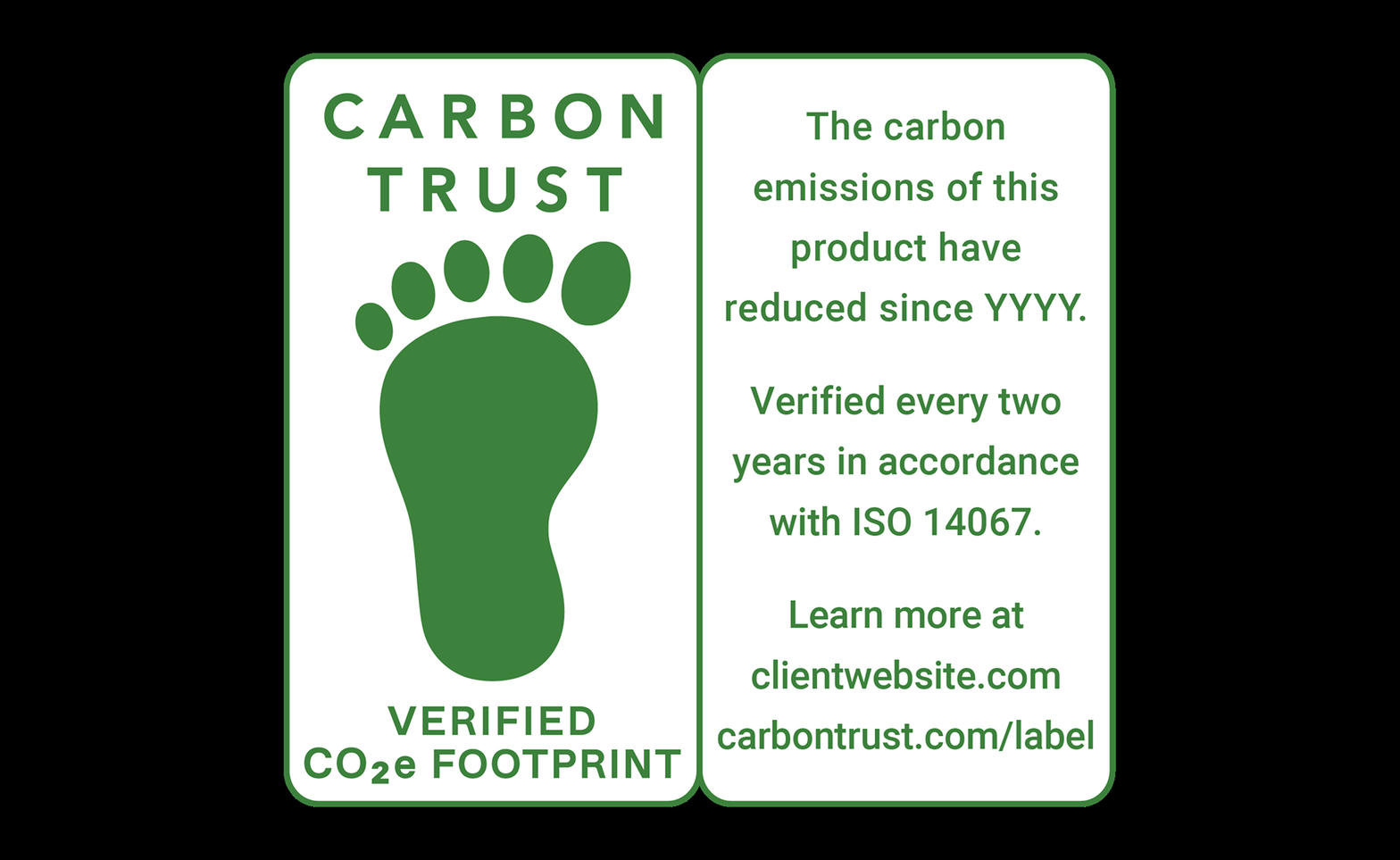
Marks and reference graphics are shown for identification, academic research and commentary. The image does not grant permission to apply a scheme mark to packaging; consult the issuing body's current eligibility and artwork rules. Licensed marks are not reconstructed as production files.
A companion to the scores
The carbon-labels article maps measurement: footprints, letter grades, multi-criteria scores. This article is about a different sentence. “Climate-neutral”, “carbon-neutral” and “climate-positive” assert a verdict — that the product’s greenhouse-gas impact has been reduced to zero or better — and they have almost always done so by buying offsets for residual emissions.
The blacklist
Directive (EU) 2024/825 of 28 February 2024 amends the Unfair Commercial Practices Directive. Member States were required to transpose it by 27 March 2026 and to apply the transposing measures from 27 September 2026. Among the practices added to Annex I — the list of commercial practices that are in all circumstances considered unfair — is: “Claiming, based on the offsetting of greenhouse gas emissions, that a product has a neutral, reduced or positive impact on the environment in terms of greenhouse gas emissions” (Directive (EU) 2024/825). The prohibition is not a documentation standard and not a waiting period. It is a ban on that form of product claim.
The same Directive separately disciplines generic environmental claims and sustainability labels. “Climate friendly” and “carbon friendly” are listed as examples of generic claims, prohibited where recognised excellent environmental performance relevant to the claim cannot be demonstrated, unless the specification appears in clear and prominent terms on the same medium. The Directive’s own illustration is packaging-specific: “the claim ‘climate-friendly packaging’ would be a generic claim, whilst claiming that ‘100 % of energy used to produce this packaging comes from renewable sources’ would be a specific claim” (Directive (EU) 2024/825). A specified energy-source claim is not thereby authorised if it is false; it simply falls outside the generic-claim prohibition and remains subject to the rest of the UCPD.
A sustainability label that is neither based on a certification scheme meeting the Directive’s conditions nor established by public authorities is likewise blacklisted (Directive (EU) 2024/825). A house “carbon-neutral” badge, designed by the brand and printed without a qualifying scheme, fails on that ground even before the offset-specific point 4c is reached.
The Carbon Trust withdrawal
The principal private verifier of on-pack carbon-neutral claims in the English-speaking market withdrew the product. “From September 2023 we are no longer offering carbon-neutral verification.” Existing labelled products “will still be in the market for some time, until required to reverify”; the organisation describes a transition toward reduction-focused labels and “language to enhance clarity of meaning” (Carbon Trust, n.d.; Carbon Trust, 2023). A pack still carrying a Carbon Trust carbon-neutral mark after September 2023 may be inside an unexpired verification period. It is not evidence that the claim can be renewed, and from 27 September 2026 it is not evidence that the claim can be made on the EU market on the basis of offsets.
The United States position
The FTC Green Guides do not ban offset-based product claims. They condition them. Carbon-offset claims must reflect appropriate quantification, must not double-count, and must disclose if the advertised emission reductions “will not occur for two years or longer” (16 CFR § 260.5). That is a substantiation-and-disclosure regime, not a blacklist. A pack lawful under § 260.5 can still be an Annex I point 4c practice in the Union. Dual-market artwork that keeps a “climate-neutral” lock-up for the United States and drops it for the EU is a consequence of that split, not of a single global standard.
Traps
Leftover Carbon Trust marks are the first trap: an unexpired verification is not a licence to reprint. The second is conflating a footprint number with a neutrality verdict — the scores article is the map of the former. The third is assuming that buying plastic credits or planting trees somewhere else can be summarised as “climate-positive packaging” on an EU pack after 27 September 2026. Point 4c is drawn in terms of greenhouse-gas offsetting and product-level impact claims. Corporate net-zero reports are not the same legal object; they are also not a defence for the on-pack sentence. No millimetre specification exists for a banned claim, and none is offered.
References
Directive (EU) 2024/825 of the European Parliament and of the Council of 28 February 2024. OJ L, 2024/825, 6.3.2024.. Available at: Open source (Accessed: 22 August 2026).
Carbon Trust (n.d.) Carbon-neutral verification.. Available at: Open source (Accessed: 22 August 2026).
Carbon Trust (2023) What’s new with our product carbon footprint labels?, 26 September.. Available at: Open source (Accessed: 22 August 2026).
16 CFR § 260.5 Carbon offsets.. Available at: Open source (Accessed: 22 August 2026).
Note on sources and verification
Annex I point 4c, the generic-claim examples including “climate friendly” and “carbon friendly”, the climate-friendly-packaging illustration, the sustainability-label prohibition, and the 27 March 2026 / 27 September 2026 dates are from the EUR-Lex HTML of Directive (EU) 2024/825. The Carbon Trust withdrawal and the run-off of existing verifications are from the organisation’s carbon-neutral verification page and its 26 September 2023 news post. Section 260.5 is the eCFR text. This article does not treat measurement labels, letter grades or PEF-style scores except to distinguish them; those instruments are in the companion article.
Last verified: 22 August 2026.