On this page
Bio-based marks: carbon-14 content is not compostability
Status
Voluntary scheme marks. OK biobased is operated by TÜV AUSTRIA; the USDA Certified Biobased Product label is the voluntary labelling arm of the BioPreferred programme. Neither mark is a compostability, recyclability or biodegradability certification. From 27 September 2026, “biobased” is listed in Directive (EU) 2024/825 as an example of a generic environmental claim.
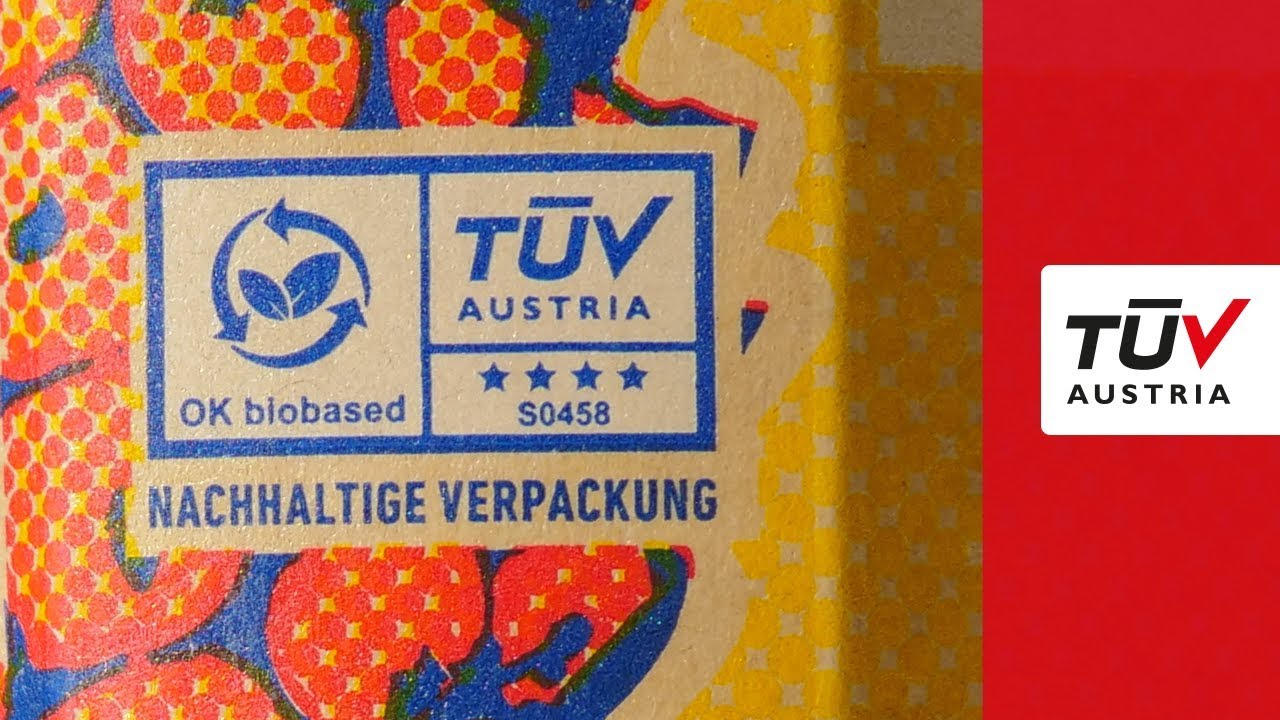
Marks and reference graphics are shown for identification, academic research and commentary. The image does not grant permission to apply a scheme mark to packaging; consult the issuing body's current eligibility and artwork rules. Licensed marks are not reconstructed as production files.
The proposition
A bio-based mark asserts a fact about feedstock age, not about fate. Radiocarbon methods distinguish “young” carbon, with C14 activity from plants, from “old” fossil carbon, whose C14 has decayed to about zero. TÜV AUSTRIA’s description of OK biobased puts it in those terms: a product with 80 per cent C14 activity “consists of 80% renewable and 20% fossil carbon”.
That is a different proposition from every other content family in this theme. Recycled-content marks, treated in the certification article, assert a material history (this carbon has been a product before). Compostability marks, treated in the certification-marks article, assert a fate in a named environment. Bio-based marks assert neither. They can sit on a durable, non-compostable, non-recyclable article. They frequently do.
OK biobased
OK biobased is a voluntary certification of TÜV AUSTRIA. Two thresholds are conditions of any star rating: the product’s total carbon content must be at least 30 per cent, and its biobased carbon content at least 20 per cent (TÜV AUSTRIA, n.d.). Above that floor the scheme grades by stars: one star for 20–40 per cent biobased carbon, two stars for 40–60, three for 60–80, four for more than 80 per cent (TÜV AUSTRIA, n.d.; Beta Analytic, describing the same programme). The label may be applied to raw materials, intermediates and finished products — but “a product may bear the OK biobased label only if the complete product is certified” (TÜV AUSTRIA, n.d.). A bio-based lid on a fossil tub does not licence a pack-level OK biobased mark.
The scheme is not OK compost, OK biodegradable SOIL or OK biodegradable MARINE. Those are separate TÜV AUSTRIA programmes with separate test methods, treated elsewhere in this group. Displaying an OK biobased star rating next to a compostability claim, or treating the star count as a general environmental score, extends the certificate beyond the C14 measurement it records. No millimetre table is published on the scheme’s public page; artwork is a licence condition, not a statutory specification, and is not reconstructed here.
USDA Certified Biobased Product
The United States programme has two arms that share a measurement and not a mark. Federal purchasing preference, under the BioPreferred programme, requires listed product categories to meet USDA-set minimum biobased contents. The voluntary labelling initiative is separate: after USDA screening, ASTM D6866 verifies the percentage displayed on the USDA Certified Biobased Product label (USDA BioPreferred, n.d.a). Products that fall within an established category must meet or exceed that category’s minimum. Products that do not “must contain at least 25% biobased content”, though applicants may propose an alternative minimum; USDA states that the 25 per cent floor “will be reviewed by USDA at some future date” (USDA BioPreferred, n.d.a).
The catalogue legend is explicit that the symbol may apply to “a product or package” whose biobased contents “have been third-party tested at independent laboratories” (USDA BioPreferred, n.d.b). Packaging can therefore be the certified object, not merely the vehicle for a certified product. Where the certified item contains inorganic carbon or other substances the method ignores, USDA recommends that the certification holder “qualify the percentage of these excluded compounds on the product's packaging”, pointing to the programme’s brand guidelines (USDA BioPreferred, n.d.a). Those brand guidelines were not retrieved as a millimetre specification for this article; no millimetre figure is stated here. USDA also states that it will routinely audit certified products and packaging against the biobased content displayed on the label (USDA BioPreferred, n.d.c).
Generic-claims law
From 27 September 2026, Directive (EU) 2024/825 treats “biobased” as an example of a generic environmental claim, alongside “eco-friendly”, “climate friendly” and “biodegradable”. A generic claim is prohibited where the trader cannot demonstrate recognised excellent environmental performance relevant to the claim — unless the specification of the claim is provided “in clear and prominent terms on the same medium”, for example the product’s packaging (Directive (EU) 2024/825). A bare “biobased” on an EU pack is therefore a different legal object from an OK biobased star rating issued under a third-party scheme. The star rating is a sustainability label that still has to satisfy the Directive’s certification-scheme or public-authority conditions, examined in the self-declared-labels article. The word on its own is a generic claim.
Traps
Bio-based is not biodegradable, not compostable and not recycled. A four-star OK biobased rating can describe a persistent polymer. The complete-product rule is the one most often missed in component-level marketing. USDA’s 25 per cent figure is a default for uncategorised products, not a universal minimum and not a European threshold. C14 methods ignore inorganic carbon: a high mineral-filled pack can show a high biobased-carbon percentage on a small organic fraction. Neither scheme’s public pages located for this article state a millimetre size; do not invent one from a brand kit.
References
TÜV AUSTRIA (n.d.) OK biobased.. Available at: Open source (Accessed: 22 August 2026).
USDA BioPreferred (n.d.a) Certification criteria.. Available at: Open source (Accessed: 22 August 2026).
USDA BioPreferred (n.d.b) Catalog.. Available at: Open source (Accessed: 22 August 2026).
USDA BioPreferred (n.d.c) FAQs.. Available at: Open source (Accessed: 22 August 2026).
Directive (EU) 2024/825 of the European Parliament and of the Council of 28 February 2024 amending Directives 2005/29/EC and 2011/83/EU as regards empowering consumers for the green transition. OJ L, 2024/825, 6.3.2024.. Available at: Open source (Accessed: 22 August 2026).
Note on sources and verification
OK biobased thresholds, the complete-product rule and the C14 explanation are from TÜV AUSTRIA’s scheme page. Star bands are as stated there and in aligned laboratory descriptions of the same programme; the scheme page itself describes one- to four-star certification on the basis of the determined percentage. USDA measurement method, category minima, the 25 per cent default, packaging-as-certified-object, inorganic-carbon qualification and audit practice are from the BioPreferred certification-criteria, catalogue and FAQ pages. No millimetre specification for either mark was located on those public pages and none is stated. “Biobased” as a generic-claim example is quoted from Directive (EU) 2024/825. DIN-Geprüft and EN 16785 schemes are not characterised here because their current public criteria were not retrieved for this article.
Last verified: 22 August 2026.