On this page
Comparing the national disposal-labelling schemes: which design works best?
Marks and reference graphics are shown for identification, academic research and commentary. The image does not grant permission to apply a scheme mark to packaging; consult the issuing body's current eligibility and artwork rules.
Introduction
Voluntary disposal-labelling schemes now operate in most large consumer markets, and their designs have diverged. North America’s How2Recycle grades packaging by measured access to infrastructure. The United Kingdom’s OPRL issues a near-binary verdict. Australasia’s ARL treats conditional instructions as a first-class label state. The Nordic pictograms match pack to bin. France’s Triman is a statutory sorting mark, not a voluntary scheme, and is included because it occupies the same surface.
This article compares the five schemes on their own published rules, then sets out the three design axes on which they differ. The question of which design performs best in use is treated in the evidence theme; what the comparison establishes is that the schemes are not better and worse executions of a single idea but different answers to different questions.
The schemes on their own terms
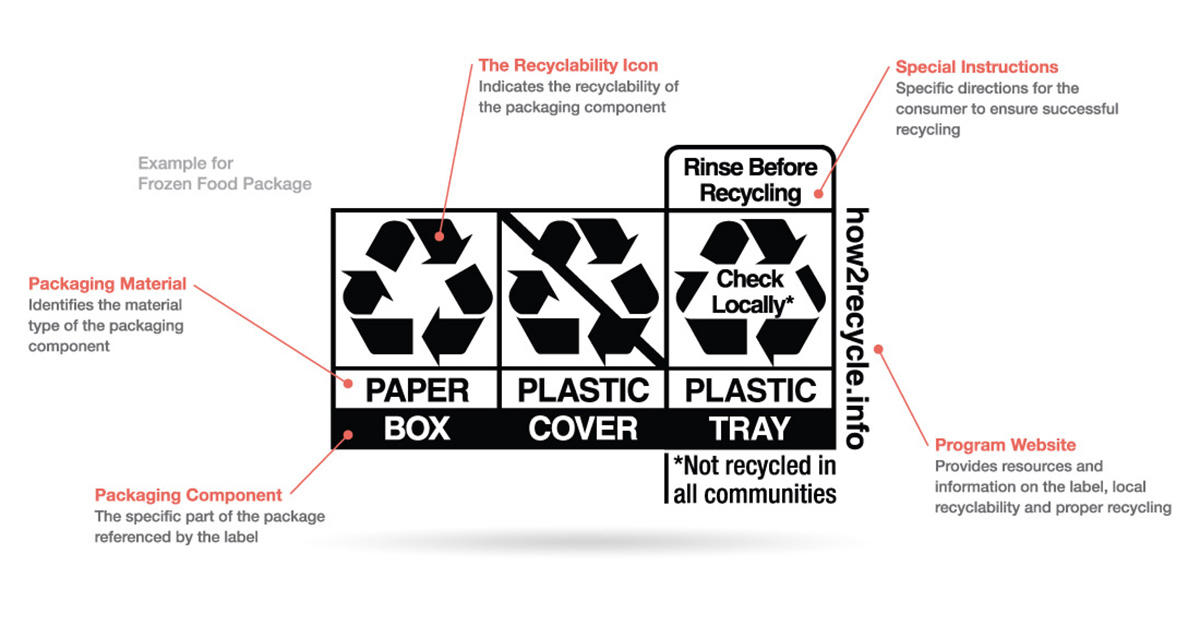
How2Recycle (US/Canada, from 2008) assigns each packaging component one of four designations anchored in population access: "Widely Recyclable" at 60 per cent US / 50 per cent Canadian access, "Check Locally" below that, "Store Drop-off" for US retail film collection, and "Not Yet Recyclable" below 20 per cent access or where sortation, reprocessing or end-market challenges are significant (How2Recycle, n.d.). The thresholds track the FTC Green Guides' 60 per cent "substantial majority" test for unqualified claims (16 CFR § 260.12). Its 2025–26 "Pro" redesign removed chasing-arrows iconography from every tier except Widely Recyclable (GreenBlue, 2025), extending access-graded caution to the scheme's own visual language.
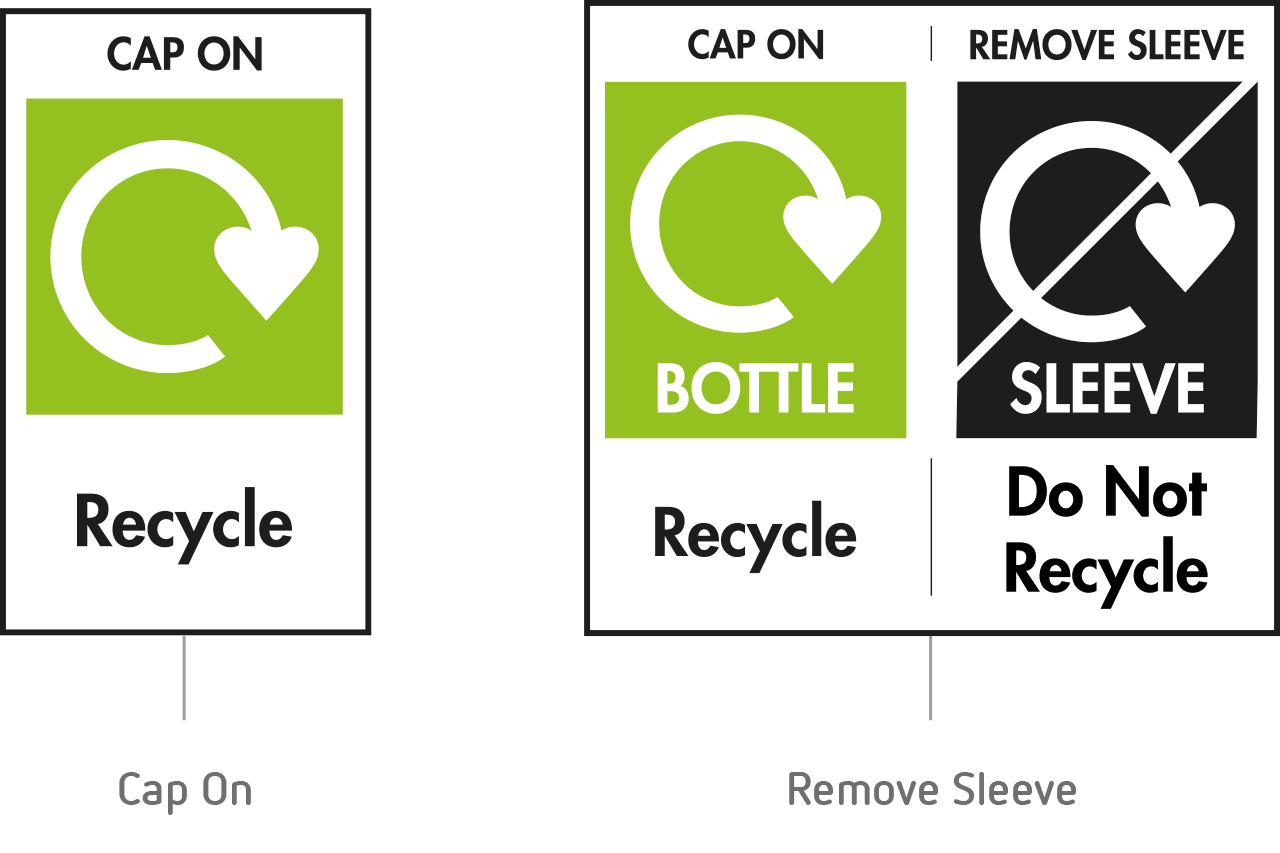
OPRL (UK, from 2009) occupies the minimalist position. Its core labels are binary, comprising "Recycle" where 75 per cent or more of UK local authorities collect the packaging type and "Do Not Recycle" where fewer than 50 per cent do, with an intermediate "Check Home Collections" status confined to a small band of formats falling between the thresholds; assessment also weighs whether the material can actually be sorted, reprocessed and sold (OPRL, n.d.). Around the binary verdict sits an instruction layer covering actions such as rinsing, flattening, sleeve removal and scrunching, together with specialist labels for take-back streams. The design proceeds on the premise that consumers act on clear yes/no instruction and that gradations of likelihood belong to the scheme's assessment rather than to the pack.
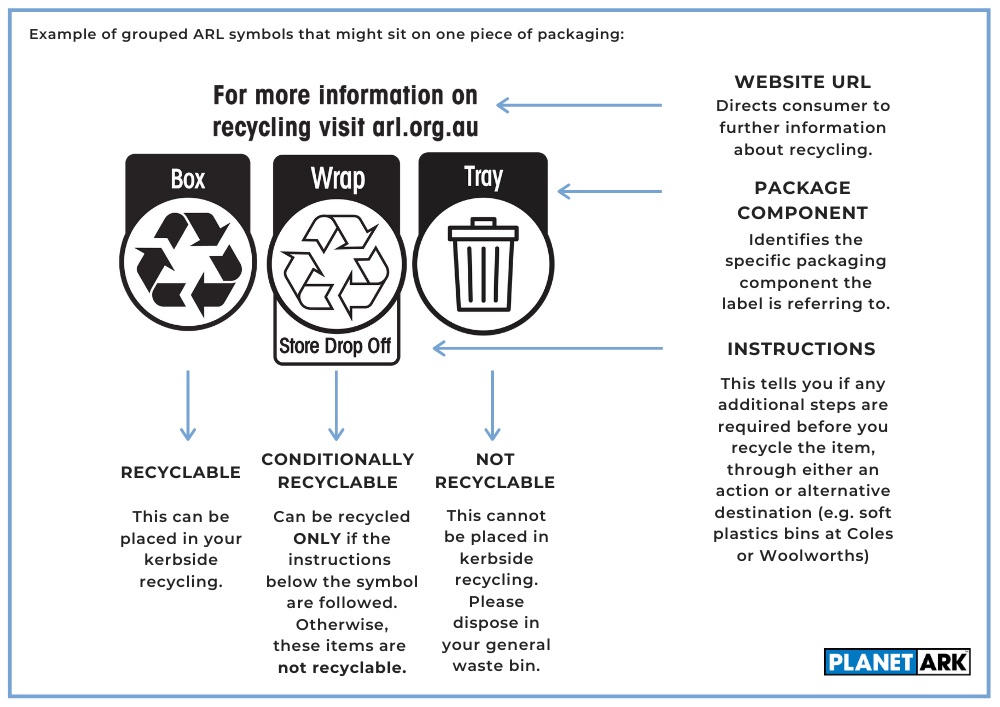
The Australasian Recycling Label (Australia/New Zealand, from 2018) makes conditionality explicit. Its three states are "Recyclable" (kerbside), "Conditionally Recyclable", denoting packaging recyclable only "if the instructions below the symbol are followed", and "Not Recyclable" (UNEP and Consumers International, 2021). The middle state distinguishes the design: whereas OPRL folds conditional cases into its binary by adjusting the verdict, the ARL prints the condition and delegates compliance to the consumer. Each label is generated from a technical assessment in the PREP evaluation tool, and the scheme is administered by APCO with Planet Ark and PREP Design under Australia's co-regulatory packaging arrangement (APCO, n.d.).
Eupicto (Nordic countries, from 2017) does not use the verdict form. Its roughly one hundred pictograms denote waste streams, comprising materials and fractions from household plastics to garden waste, and are applied identically on packaging and on bins, so that matching pictogram to pictogram constitutes the consumer task (Eupicto, n.d.). The system is free to use and administered on a not-for-profit basis; it originated for waste receptacles in Denmark in 2017 and spread by adoption to Sweden, Norway and Iceland. It makes no recyclability claim of any kind, since a stream pictogram asserts where the item goes rather than what becomes of it.
Weggooiwijzer (Netherlands) shares the routing philosophy and states its limits expressly: the scheme's operator, KIDV, explains that the logos help consumers dispose of packaging correctly while offering no guarantee that the packaging can be sorted or fully recycled, and directs recyclability questions to a separate assessment instrument (KIDV, n.d.). The scheme is positioned as an interim national solution pending the EU's harmonised labels.
Three axes of divergence
Reduced to essentials, the five designs diverge on three questions.
The content of the assertion: verdict, condition, or route
How2Recycle and OPRL assert verdicts, graded in the first case and binary in the second. The ARL asserts a verdict contingent on behaviour. Eupicto and Weggooiwijzer assert routes only. The distinction operates legally as well as cognitively, since a verdict is a recyclability claim engaging the claims-law apparatus — Green Guides thresholds, deemed-deception statutes, ISO 14021 qualification duties — whereas a routing instruction claims nothing about outcomes and is correspondingly difficult to falsify. The Dutch scheme's disclaimer states the distinction between these two speech acts directly: a package can be correctly routed into a stream that fails to recycle it, and a routing label remains truthful throughout.
The two three-state schemes illustrate the axis from within. OPRL's intermediate state, "Check Home Collections", expresses uncertainty about infrastructure, the packaging being recyclable and collection patchy. The ARL's intermediate state expresses conditionality on action, the packaging being recyclable if the consumer performs a prior step. The taxonomies are similar in form and different in function, which any cross-scheme comparison of three-category labels must take into account.
The geographic anchor of the claim
Every verdict scheme must anchor its claim somewhere. How2Recycle anchors in national access percentages, OPRL in local-authority collection counts, and the ARL in PREP's assessment against Australasian infrastructure. The anchors are incommensurable, since 60 per cent of a population, 75 per cent of collection authorities, and a technical evaluation are three different measurements; consequently identical packaging can honestly carry different verdicts across schemes, and does. This follows not from scheme failure but from the locality of recyclability itself, the structural feature examined in the global-standard article. Routing schemes avoid the problem by declining the claim, since a stream pictogram holds wherever that stream exists.
Demands placed on the reader
The designs presume different readers. OPRL's binary requires one word and one action. The ARL requires conditional compliance: read the instruction, perform it, then recycle. How2Recycle requires category comprehension and, in its middle tier, independent local research. Eupicto requires pattern-matching between package and bin, which is straightforward where bins are labelled and undefined where they are not, so that the system's packaging use is inseparable from its receptacle infrastructure. Each additional demand purchases informational precision at the cost of compliance probability, and the location of the optimum is an empirical question that the schemes have in effect answered by assumption, in opposite directions.
Scope and limitations
Two qualifications bear on any ranking of the schemes.
First, the schemes do not operate under comparable conditions. OPRL operates in a single small jurisdiction with consolidated retail; How2Recycle spans two federal states and thousands of programmes; the ARL sits inside a co-regulatory covenant; and Eupicto depends on municipal bin standardisation. Design choices therefore reflect environment in part rather than philosophy alone, since a binary label is more readily sustained where 75 per cent collection thresholds are achievable nationally, and a routing label is available where bins are uniformly labelled.
Second, published scheme rules provide no information about behavioural performance, so effectiveness cannot be inferred from design coherence. The evidence base, comprising sorting studies, comprehension research and the natural experiments of scheme transitions, is treated in the evidence theme, and it is thinner and more equivocal than the schemes' own materials suggest. What design analysis alone establishes is which failures each scheme has structurally excluded: OPRL cannot mislead by gradation, Eupicto cannot overclaim recyclability, the ARL cannot leave conditional steps implicit, and How2Recycle cannot ignore access data. Each design accordingly constitutes a choice about which error to exclude.
The instruction layer
Cutting across the verdict/route axis runs a second design element, the behavioural instruction, for which the schemes have adopted divergent grammars.
OPRL's instruction vocabulary is the most extensive of the five: its labels carry action modifiers — rinse, empty, flatten, remove sleeve, remove film, scrunch, cap on — attached to the core verdict, with specialist labels routing defined streams, such as bags and wrappings to front-of-store collection (OPRL, n.d.). The design treats instruction as supplementary, in that the verdict stands alone and the modifier optimises the quality of the compliant item. The ARL inverts that relationship for its middle state, where the instruction is constitutive: "Conditionally Recyclable" has no content apart from the instruction beneath it, and non-compliance converts the verdict to its negative (UNEP and Consumers International, 2021). How2Recycle's Pro redesign, which strips recycling vocabulary from its instruction tabs so that "Flatten before recycling" becomes simply "Flatten" (GreenBlue, 2025), marks a third position, in which instruction is decoupled from outcome language and an action is requested without recycling being promised.
These grammatical differences matter because instructions are the point at which labels meet the behavioural evidence reviewed in this collection's fifth theme: instructions are the label element most plausibly causal for sorting quality, and the element whose compliance costs fall entirely on the consumer. A scheme's instruction grammar therefore embodies its implicit account of motivation — OPRL proceeding on the basis that clear verdicts carry modifiers along, the ARL that conditional verdicts activate compliance, and How2Recycle that decoupled actions avoid overclaiming — and no comparative trial has tested the three accounts against one another, a gap recorded in the evidence agenda.
The routing schemes, symmetrically, have no instruction problem because they have no verdict to condition: Eupicto's pictogram is the instruction, in that the consumer matches the stream, and the Dutch scheme's per-fraction logos operate likewise. Their design cost appears elsewhere, in the bin-labeling infrastructure the pictograms presuppose and in the recyclability question they decline to answer (KIDV, n.d.).
Governance and label design
A further pattern emerges when the five schemes' institutional homes are set beside their design choices, in that each scheme's governance corresponds to the register of its label.
How2Recycle is operated from within a membership organisation of packaging producers and brands, and its design reflects that structure in a graded vocabulary permitting member packaging to carry some label at every tier of performance, with the claims-restraint of the Pro redesign arriving as regulatory pressure on recyclability claims increased. OPRL is likewise industry-funded but is built around retail consolidation in a single jurisdiction, and its binary verdict reflects what a scheme can promise where a small number of grocers span the market and local-authority collection data are nationally tabulable. The ARL's conditional grammar follows from co-regulation, in that a covenant scheme answerable to government targets can require more of consumers — read, act, then recycle — because its legitimacy rests on policy participation rather than on member comfort. Eupicto's stream pictograms originate in the least conflicted governance arrangement of the five, a free, not-for-profit system spread by municipal adoption, and correspondingly make the fewest claims, since no member's packaging requires a favourable verdict where no verdicts exist. The Weggooiwijzer's disclaimer corresponds to the mandate of a knowledge-institute steward whose remit is information rather than membership value.
The pattern conditions how the schemes' designs may be assessed. A label's grammar is not free design space but is negotiated within whatever institution funds the scheme, so that proposals to transplant one scheme's features into another — OPRL's binary directness into How2Recycle's membership structure, for example — are proposals to transplant governance rather than graphics. The EU's harmonised labels will test the point at scale, since pictograms specified by regulation answer to no membership, which is a condition of their adopting the routing philosophy the voluntary verdict schemes did not adopt.
Convergence, and its limits
The 2020s have moved the schemes toward one another. How2Recycle's Pro redesign moved the access-graded scheme toward OPRL-style claim restraint by reserving recycling iconography for its strongest tier (GreenBlue, 2025). The EU's incoming harmonised labels, which match packaging to labelled receptacles by pictogram, generalise the Eupicto architecture, and the Dutch scheme already describes itself as their placeholder. Claims regulation across jurisdictions presses verdict schemes toward defensible thresholds and away from unqualified symbols.
Convergence is nevertheless bounded by the axis of assertion. A single design cannot simultaneously deliver the verdict that motivates ("this is recyclable"), the condition that instructs ("if you remove the film"), and the route that operationalises ("yellow bin") without producing the composite label that comprehension research identifies as a source of difficulty. On that analysis the schemes' divergence is a design frontier rather than a coordination failure awaiting harmonisation, and the choice among the five philosophies is a choice about which consumer, and which failure mode, a jurisdiction is prepared to plan for.
References
APCO (Australian Packaging Covenant Organisation) (n.d.) The Australian Packaging Covenant. Available at: Open source (Accessed: 18 August 2026).
Eupicto (n.d.) About the pictogram system. Available at: Open source (Accessed: 18 August 2026).
GreenBlue (2025) FAQ: How2Recycle Pro label rollout. Available at: Open source (Accessed: 18 August 2026).
How2Recycle (n.d.) How2Recycle labels. Available at: Open source (Accessed: 18 August 2026).
KIDV (Kennisinstituut Duurzaam Verpakken) (n.d.) Weggooiwijzer. Available at: Open source (Accessed: 18 August 2026).
OPRL (n.d.) How the scheme works. Available at: Open source (Accessed: 18 August 2026).
UNEP and Consumers International (2021) Australasian Recycling Label case study. Available at: Open source (Accessed: 18 August 2026).
16 CFR § 260.12 (Recyclable claims). Available at: Open source (Accessed: 18 August 2026).
Note on sources and verification
Scheme descriptions are drawn from each operator's own published rules as cited; assessment procedures internal to the schemes (How2Recycle's review depth, PREP's evaluation logic) are characterised only to the extent their public materials state. The Eupicto pictogram count of roughly one hundred follows the system's own description and should be treated as approximate. Launch years are as follows: How2Recycle 2008 (per its own site), OPRL 2009 (per its own site), the ARL 2018 (per the UNEP/Consumers International case study), Eupicto's Danish adoption 2017 (per its own site). The comparative analysis of design axes is original to this article; no external source is claimed for it.
Last verified: 18 August 2026.