On this page
How2Recycle: how does the dominant North American scheme work, and what changed in the relaunch?
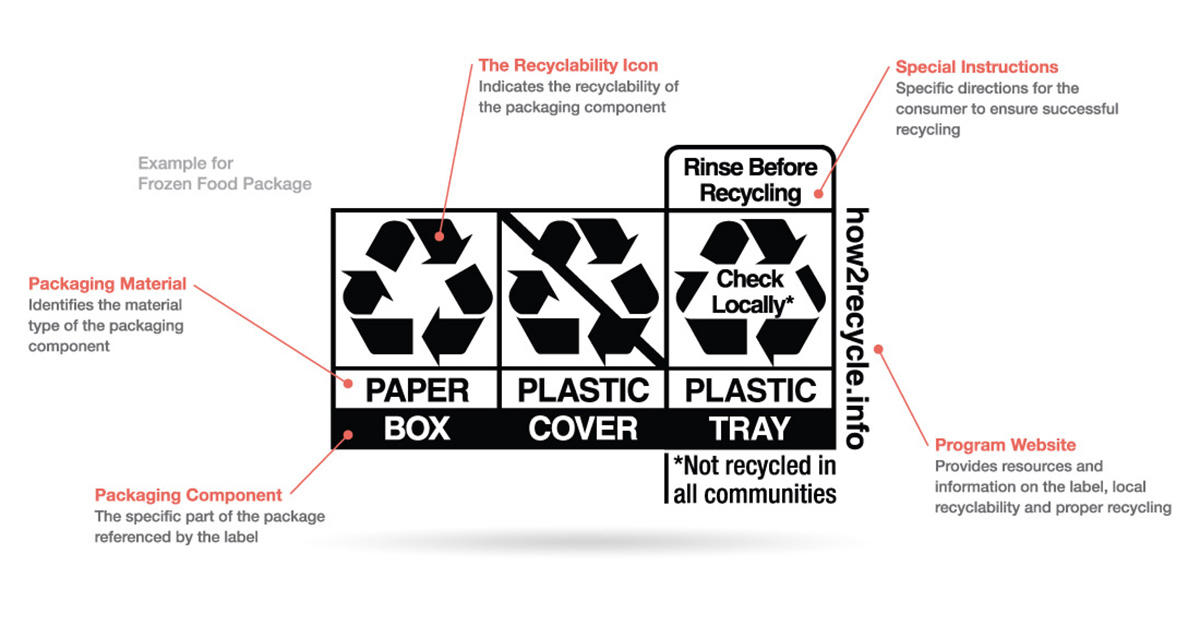
Marks and reference graphics are shown for identification, academic research and commentary. The image does not grant permission to apply a scheme mark to packaging; consult the issuing body's current eligibility and artwork rules.
Introduction
How2Recycle is the principal disposal-labelling scheme in North America. It is operated from within the Sustainable Packaging Coalition, launched in 2004 by GreenBlue. The programme began in 2008 and now labels packaging across a large share of the US and Canadian grocery shelf. Designations rest on measured access to recycling, not on a resin number.
The label system
How2Recycle's architecture differs from its European counterparts in one respect of principle: it is built directly on measured access to recycling infrastructure, category by category.
Each packaging component receives one of four designations. "Widely Recyclable" applies where "at least 60% of Americans and 50% of Canadians can recycle these packages through curbside or drop-off programs". "Check Locally" applies where access falls below those thresholds. "Store Drop-off", applicable in the US only, covers polyethylene film returnable to participating retail collection points. "Not Yet Recyclable" applies where fewer than 20 per cent have access "or there are significant challenges in sortation, reprocessing, or end markets" (How2Recycle, n.d.b).
Three features of this design may be distinguished. First, the 60 per cent threshold tracks the Federal Trade Commission's Green Guides, under which an unqualified recyclable claim requires facilities available to "a substantial majority of consumers or communities", defined as "at least 60 percent" (16 CFR § 260.12); the scheme therefore operationalises federal guidance as a labeling taxonomy. Second, the designations are assigned per component — bottle, cap, label, sleeve — rather than per package, which reflects the circumstance that a single pack's parts follow different end-of-life paths. Third, the middle categories carry informational content rather than functioning as hedges: "Check Locally" is an access statement, and "Not Yet Recyclable" makes a negative assertion that voluntary schemes have historically been reluctant to print. The willingness to label packaging as not recyclable, and to instruct disposal in the trash, distinguishes the scheme from unqualified use of the chasing arrows, which asserts recyclability without reference to access.
The assignments rest on access data and technical assessment rather than self-declaration: membership involves submission of packaging specifications, and labels are issued through the program's platform following review. In this respect How2Recycle occupies a position between the self-declared claims governed by ISO 14021 and audited certification, in that the label is licensed and reviewed while the underlying scheme is an industry collaborative rather than an accredited conformity-assessment body.
The relaunch: the Pro label
In 2025 the program replaced its legacy labels with the "How2Recycle Pro" system. The transition mechanics were specified in advance: the member platform closed on 25 August 2025 and reopened with Pro labels on 4 September 2025, and 1 February 2026 was "the last date Legacy Label proofs will be approved", after which only Pro labels are eligible (GreenBlue, 2025a; 2025b).
Two design changes carry the substance. The Pro label "removes the chasing arrows iconography from all tiles except for Widely Recyclable", and strips the words recycle, recyclable and recycling from instruction tabs, so that "Flatten before recycling" becomes "Flatten" (GreenBlue, 2025b). Both changes operate in the same direction: the visual and verbal apparatus of recyclability is reserved for the tier at which the access evidence supports an unqualified claim, and withheld elsewhere.
The proximate cause was Californian. SB 343 deems the chasing arrows, or any symbol implying recyclability, deceptive on packaging that fails the statute's access and processing criteria, and the scheme's own materials note the California compliance deadline of 4 October 2026 (GreenBlue, 2025b; Cal. Pub. Res. Code § 42355.51). A legacy "Check Locally" label carrying arrows on a package that California deems non-recyclable would fall within the statute's scope. The Pro redesign, confining arrows to packaging for which "Widely Recyclable" is established, accordingly conforms voluntary labeling to the strictest applicable law so that a single label may be used across every US market. That the statute's enforcement was preliminarily enjoined in July 2026 (National Law Review, 2026) does not unwind the redesign: the injunction restrains state enforcement while litigation proceeds, private exposure under general consumer-protection law remains, and the program had in any event completed its transition before the ruling.
The relaunch also illustrates a property of private schemes that statutory systems do not share. The interval from announcement to legacy cut-off was under a year, within which a full redesign, member migration and artwork transition were executed, whereas statutory labeling regimes have operated on longer timescales.
Scope of the label's assertion and its limits
A How2Recycle label asserts that the program has assessed the component against its access data and assigned the printed designation. It does not certify that any particular consumer's programme accepts the item, since "Widely Recyclable" is compatible with 40 per cent of Americans lacking access. It does not certify recycled content, compostability, or any production attribute, the scheme's scope being confined to end-of-life communication. It is not a government label, although its thresholds track federal guidance. Outside the US and Canada it asserts nothing, because the access data underlying every designation are North American, so that the label's appearance on export packaging is an artefact of shared artwork rather than a claim about another market's infrastructure.
Two lines of objection have been advanced against the scheme. The first is that access-based labeling overstates real recycling, since access measures the offer of collection rather than whether collected material is sorted, reprocessed and sold, which is the distinction at the centre of the broader recyclability-measurement debate treated elsewhere in this collection. On that view, even a truthful "Widely Recyclable" label communicates more environmental accomplishment than the system delivers. The second objection was directed at the legacy design specifically, on the ground that arrows-bearing labels on marginal materials functioned as reassurance rather than information. The Pro redesign addresses the second objection; the first remains open and applies to every access-threshold scheme rather than to How2Recycle alone.
The evidence base beneath the labels
A scheme whose designations turn on access percentages depends upon its access measurement, and the properties of that measurement bear examination.
Access in the How2Recycle architecture means availability of collection, whether curbside or drop-off, for the packaging category, aggregated to national population shares. Three properties of that metric shape what the designations can support. It is categorical, in that the measured unit is the packaging type — PET bottles, PP tubs, PE film — so that a designation asserts access for the category and atypical members of a category inherit percentages earned by their mainstream counterparts. It is offer-side, in that access measures the invitation to recycle rather than participation, sortation success, reprocessing or end-market clearance, each of which is a step at which actual recycling diverges from measured access; that divergence is the gap quantified in the evidence theme. It is threshold-sensitive at the margin, in that a category at 58 per cent access and one at 62 sit on opposite sides of the scheme's central boundary while differing little in substance, which is the arbitrariness that any threshold system carries and which is given consequence here by the Green Guides' 60 per cent anchor (16 CFR § 260.12).
None of this is concealed, since the scheme's definitions state the access basis expressly (How2Recycle, n.d.b), but the label compresses it, in that "Widely Recyclable" may be read at the shelf as a statement about outcomes while asserting, under the rules, a statement about the availability of collection. The Recycling Partnership's consumer research indicates how such compression is received: among US consumers who examine labels, 63 per cent report confusion about whether an item is recyclable after looking (The Recycling Partnership, 2021). That finding spans the labeling landscape rather than bearing on any single scheme, but it establishes the comprehension conditions under which any access label operates.
The Pro redesign may be read as the scheme's response to that compression. Removing recycling iconography and vocabulary from every tier below the access-substantiated one narrows the range of readings under which the label promises more than the access data support (GreenBlue, 2025b), which corresponds within the market to the proportional-qualification logic that claims law applies from outside.
The scheme in the labeling system
How2Recycle's relationship to public governance runs in both directions.
Downstream, the scheme translates law into artwork. The Green Guides' 60 per cent test, SB 343's criteria, and the state resin-code mandates reach individual packages largely through the program's design decisions, so that most brand owners encounter US claims law in the form of How2Recycle's rules rather than as statutes.
Upstream, the scheme shapes the law it translates. Its access data and category architecture are reference points in regulatory proceedings; the National Academies' 2025 recommendation of a national recycling label standard describes, in institutional form, an arrangement resembling what How2Recycle built privately (National Academies, 2025); and the 2026 federal preemption bill's tiered access thresholds correspond to the scheme's own gradations. Should federal legislation occupy this space, absorption of the scheme's template is at least as likely an outcome as its displacement, voluntary schemes elsewhere having become the substance of statutory systems.
The comparative position, developed in the scheme-comparison article, is that How2Recycle occupies one pole of a design space, offering fidelity to measured infrastructure at the cost of complexity and of a vocabulary — "Check Locally" — that presupposes an engaged reader. The relaunch demonstrates the model's adaptability; whether the model's premise, that consumers act on component-level access information, survives behavioural scrutiny is a question for the evidence theme.
Public functions and private governance
The scheme's position within the governance framework developed in this collection's first theme is that of an actor performing functions that regulation performs elsewhere.
In a market without a mandatory disposal label, the voluntary scheme's choices allocate what regulation allocates in other jurisdictions: which claims reach consumers, through its designations; what evidence supports them, through its access data and review; how legal abstractions are operationalised, through thresholds tracking the Green Guides; and how conflicts between jurisdictions are resolved on shared artwork, through the Pro redesign's conformity to the strictest market. These are public functions performed privately. The scheme retooled its entire label system within a year of the regulatory pressure described above, whereas the federal guidance apparatus has not answered that pressure in over a decade.
The structural tensions are those characteristic of private governance. Accountability runs to members rather than to the consumers the labels address; the access data underpinning designations are programme-generated rather than independently audited to a public standard; and the scheme's dual position, as service provider to producers and as de facto arbiter of their claims, embeds the conflict that certification bodies manage, without the accreditation architecture that disciplines formal certifiers. These features do not bear on the scheme's integrity, but they define what is at stake in the National Academies' national-label recommendation (National Academies, 2025). Whether the American answer is a public standard absorbing the private template, or continued delegation by default to the scheme, is among the market decisions tracked in the jurisdiction pages of this collection.
The comparative register clarifies the terms of that decision. Jurisdictions that mandated disposal labels, such as France with Triman and the EU with its incoming harmonised pictograms, obtained uniformity and public accountability, whereas the responsiveness a voluntary scheme demonstrated in its year-long Pro retooling was obtained by the United States through default to the private scheme. Neither settlement dominates the other on the evidence assembled here: mandated systems can fix errors in regulation, given the multi-year processes required to amend a statutory pictogram, while voluntary systems can correct quickly but answer structurally to their members. The How2Recycle case contributes to that comparison the demonstration that a member-funded scheme can move against member convenience where claims-law pressure aligns incentives, since the Pro redesign made members' packaging less favourably labeled and the membership absorbed the change. Whether that alignment holds in the absence of such pressure is an untested condition of the American arrangement.
References
Cal. Pub. Res. Code § 42355.51. Available at: Open source (Accessed: 18 August 2026).
GreenBlue (n.d.) About. Available at: Open source (Accessed: 18 August 2026).
GreenBlue (2025a) Pro label rollout. Available at: Open source (Accessed: 18 August 2026).
GreenBlue (2025b) FAQ: How2Recycle Pro label rollout. Available at: Open source (Accessed: 18 August 2026).
How2Recycle (n.d.a) About. Available at: Open source (Accessed: 18 August 2026).
How2Recycle (n.d.b) How2Recycle labels. Available at: Open source (Accessed: 18 August 2026).
National Academies of Sciences, Engineering, and Medicine (2025) Municipal Solid Waste Recycling in the United States: Analysis of Current and Alternative Approaches. Washington, DC: The National Academies Press. doi:10.17226/27978.
The Recycling Partnership (2021) Consumer Research on Recycling Behavior and Attitudes Regarding On-Pack Labeling. Available at: Open source (Accessed: 18 August 2026).
National Law Review (2026) California SB 343 enforcement preliminarily enjoined. Available at: Open source (Accessed: 18 August 2026).
16 CFR § 260.12 (Recyclable claims). Available at: Open source (Accessed: 18 August 2026).
Note on sources and verification
The program's membership scale is described qualitatively; a current membership count was not verified and is not asserted. The account of the Pro rollout — platform dates, legacy cut-off, removal of arrows and of recycling vocabulary from instruction tabs, and the California deadline reference — is drawn from GreenBlue's own rollout announcement and member FAQ. The characterisation of label issuance as involving specification review reflects the program's member documentation; the depth of technical review per SKU was not independently assessed. The statement that How2Recycle labels are the primary recyclability communication encountered by most American consumers is an inference from the scheme's market position rather than a measured media-exposure finding.
Last verified: 18 August 2026.