On this page
Forestry and material sourcing marks: what do FSC, PEFC and SFI claims certify?
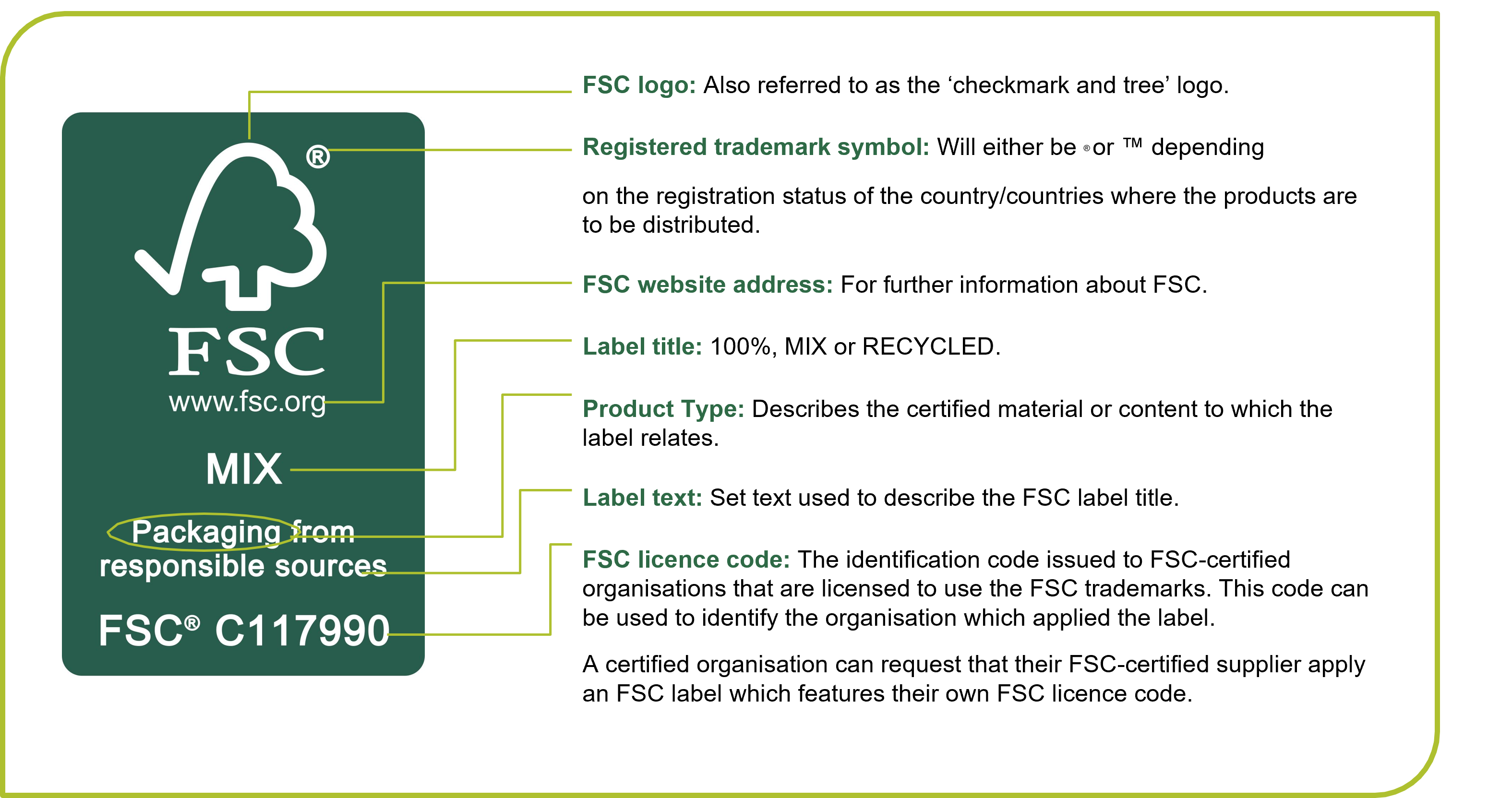

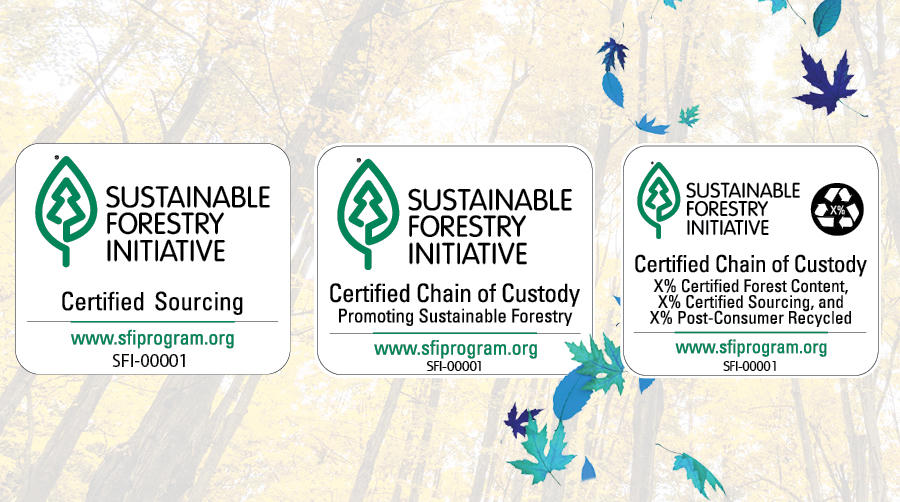
Marks and reference graphics are shown for identification, academic research and commentary. The image does not grant permission to apply a scheme mark to packaging; consult the issuing body's current eligibility and artwork rules.
Introduction
The other mark families in this section concern where the package goes. Sourcing marks concern where it came from. An FSC checkmark-and-tree, a PEFC twin-tree ring or an SFI legend on a carton certifies facts about origin and custody. It asserts nothing about disposal. These marks still appear on the same panel as recycling symbols, and share their visual register.
The two-certificate architecture common to the family
The three major systems share a two-certificate architecture, which may be stated before the differences between them are set out.
Forest management certification attests that a forest is managed to the scheme's standard, comprising the ecological, social and silvicultural criteria applied on the ground. Chain-of-custody certification attests that certified material was tracked through each transformation and trade from that forest to the finished product. Only the chain of custody licenses an on-product mark: a paper mill or converter without chain-of-custody certification cannot pass the claim forward, however the forest of origin is certified. The FSC trademark standard states the condition directly. To use the FSC trademarks, "the organization shall have a valid FSC trademark licence agreement and hold a valid certificate", and every use carries the licence code that ties the mark to the certificate (FSC, 2021). PEFC's terms are equivalent: its logo and initials "are the exclusive property of PEFC and are internationally registered trademarks", usable on product only where chain-of-custody certification and a logo licence are held (PEFC, n.d.).
The family is accordingly supported by an institutional apparatus comprising owned trademarks, accredited certification bodies, licence codes and revocation machinery. The governance of that apparatus is not the subject of this article. The subject is semantic: what the licensed words on the label assert, which differs by scheme and by label variant in ways carried by the accompanying wording rather than by the seal itself.
FSC: three label variants and their respective claims
The Forest Stewardship Council's on-product system distinguishes three claims. FSC 100% asserts material derived entirely from FSC-certified forests. FSC Recycled asserts material derived entirely from reclaimed sources; the variant is a sourcing mark performing recycled-content work, with the fibre-specific feature that reclaimed paper constitutes a certified custody stream in its own right. FSC Mix, the label appearing on the majority of FSC-certified packaging, asserts a controlled blend comprising certified material, reclaimed material and "controlled wood", the last being uncertified fibre screened against the scheme's exclusions, among them illegal harvest and the destruction of high-conservation-value forest, combined under volume-credit accounting within certified custody chains (FSC, 2021; FSC, n.d.).
The accounting basis of the Mix label warrants precise statement, because volume-credit accounting tracks the certified share at the level of the system rather than at the level of the individual package. An FSC Mix carton accordingly asserts participation in a controlled and audited blending system; it does not assert that any stated fraction of the fibre in that particular carton originated in a certified forest. The claim is defined and subject to audit, and it is structurally of the same type as the attribution claims examined in the mass-balance article: a system-level assertion carried on a product label. The consumer literature identified for this article provides no basis for concluding that purchasers distinguish the two.
PEFC: endorsement of national schemes
The Programme for the Endorsement of Forest Certification operates on a different logical structure. It functions as a mutual-recognition umbrella, endorsing national forest-certification systems that meet its sustainability benchmarks. A PEFC label therefore asserts conformity with a PEFC-endorsed national scheme, the specific standard applying varying by country of origin. Its product labels parallel those of FSC: a certified label requiring at least 70 per cent certified material from PEFC-endorsed sources with the remainder controlled, together with a recycled variant (PEFC, n.d.).
The umbrella structure is simultaneously the scheme's stated design rationale and the principal object of criticism directed at it. The structure accommodates variation in national forestry conditions and in national sovereignty over forest policy, and PEFC attributes to it the scale of certified area recorded in its published figures; it produces, correspondingly, inter-scheme variation that a single global label does not display. The label's assertion is on that account one step further removed than FSC's: not that the criteria of a single scheme were met, but that criteria endorsed through that scheme's benchmarking process were met in a specified place.
SFI: label types and the certified sourcing variant
The Sustainable Forestry Initiative, the North American system, constrains one label variant more explicitly than the others. SFI's on-product system spans chain-of-custody labels, with certified-content and recycled-content variants; a forest-management label; and the Certified Sourcing label, whose semantics Section 6 of the scheme's rules states expressly: the certified sourcing label "does not make claims about certified forest content" (SFI, 2022). What the label does assert is conformity with SFI's fibre-sourcing standard, namely that the fibre arrived through a system meeting requirements on sourcing practice, including sourcing from recycled content, from certified forests, or from non-controversial sources screened to the standard, without any representation that the product contains certified-forest material.
The variant therefore carries the scheme's full visual presentation while its operative claim is an attestation concerning procurement practice rather than product content, and it is distinguishable from SFI's content labels by accompanying wording alone. Sourcing-practice standards of this kind operate in fibre baskets where forest certification is sparse. Their on-product deployment nonetheless transfers scheme-level credibility to a claim narrower than the seal presents, which is the structural pattern this theme records across mark families generally.
Scale, and the extension of the architecture to other materials
The systems' respective footprints frame their packaging significance. PEFC's published figures record hundreds of millions of certified hectares, a substantial share of all certified forest globally, together with chain-of-custody certificates in the tens of thousands across dozens of countries (PEFC, n.d.b), whereas FSC's materials claim majority worldwide recognition of its logo among consumers (FSC, n.d.b). The two claims describe different assets: certified supply in the first instance and logo salience in the second. Packaging fibre, as the certified product stream with the highest consumer visibility, is where the salience is traded.
Beyond the forest systems, the sourcing architecture extends to packaging's other materials, with differences of application. The Aluminium Stewardship Initiative operates the same two-standard anatomy, comprising a performance standard spanning the metal's chain from mine to remelt and a chain-of-custody standard governing material flow; it functions, however, principally as business-to-business assurance, no consumer on-pack ASI mark having the currency of the fibre seals, and its claims discipline operating through its own claims guidance rather than through shelf communication (ASI, n.d.). Cradle to Cradle certification, spanning material health, circularity, climate, water and social criteria across Bronze-to-Platinum achievement levels, occupies the multi-attribute end of the field, its 2026 restructuring deriving distinct certification scopes, including a dedicated circularity certification, from a single Version 5 standard (C2C, n.d.). Both extensions exhibit the family pattern: sourcing and stewardship marks certify upstream conduct through custody chains, whatever the material, and none of them — aluminium, fibre or multi-attribute — carries information about disposal.
The extensions also make explicit a feature of fibre packaging in particular. Fibre is packaging's most recycled material stream and its most sourcing-certified; the two properties are governed by entirely separate mark systems, are asserted on the same carton, and are counted by different institutions toward different objectives. A reader seeking a complete environmental account of a paper package must therefore combine a custody claim, a recyclability status and, increasingly, a recycled-content figure: three marks, three governance families, and no common denominator, no label system at present performing the integration.
Limits of the assertion
The propositions the sourcing marks do not establish may be stated directly.
No sourcing mark asserts recyclability. The certified carton and the uncertified carton enter identical fibre streams, and recyclability turns on coatings, laminates and local collection systems, on which the forest marks are silent. No sourcing mark asserts recycled content, with the exception of the recycled variants, which assert precisely that through sourcing-certification machinery; the family accordingly contains both marks that do not address the question and marks that answer it, distinguishable only by reading the accompanying wording. No sourcing mark instructs disposal, no bin, stream or action following from any of them. None asserts carbon performance, local production or the absence of plastic, these being inferences that the seals' natural iconography may invite and that their standards nowhere support. None asserts that the package as a whole is sustainable: the certification attaches to fibre custody, whereas the package's plastic windows, metallised layers and closures stand outside the claim entirely.
Whether consumers in fact conflate sourcing marks with recyclability marks has not been established. Searches conducted for this article located no peer-reviewed test of the question, the comprehension literature's attention having been directed instead to the recycling symbols. The conflation hypothesis is accordingly recorded here as a hypothesis rather than as a finding (see the note on sources and verification).
Applied reading of a fibre package
The family's distinctions may be illustrated on a worked example.
A carton carries an FSC Mix seal with licence code, a Mobius loop with "80%", and a local disposal instruction. Three marks are present, drawn from three governance families and carrying three separable assertions. The FSC Mix seal, checked against its code, asserts audited custody of a controlled blend of certified, reclaimed and screened material through the volume-credit system, and asserts nothing about this carton's certified fraction. The percentage loop asserts recycled content under self-declaration or scheme audit, governed by the content-claim machinery of this theme's third group; it is an assertion about origin that neither confirms nor conflicts with the custody seal, since reclaimed fibre serves both. The disposal instruction asserts the local system's routing, on the disposal-label logic of the first group. Nothing on the package asserts recyclability in practice for any particular municipality, the carton's coating chemistry, or its climate performance. The three printed marks' joint visual effect is an ensemble of environmental assurance whose components are not additive.
The distinctions support a reading procedure which may be stated descriptively. Each mark is identified by family before its message is read. Where a licence code exists, the mark is checkable against a register, whereas code-free marks are assertions that cannot be so verified. Each mark translates into a narrow claim, and the claims do not aggregate. The absence of a family's mark is itself informative: a carton without custody certification is unclaimed rather than condemned, and an unlabelled disposal route indicates that the local system, rather than the package, holds the answer. The seals are narrowly drawn instruments, and the aggregation their coexistence invites is not supported by any of them individually.
Adjacent regulatory developments
Two developments bear on the sourcing marks' near-term position. The EU's deforestation regulation regime moves sourcing assurance from voluntary label to import precondition for wood and derived products, due diligence on deforestation-free origin becoming a condition of market access, with the certification systems repositioning as compliance evidence rather than as points of differentiation. That pattern of conscription into compliance architecture is recorded elsewhere in this collection across certified families generally.
The tightening of claims law reaches the sourcing marks from the opposite direction. As generic environmental claims become subject to per se prohibition in Europe, third-party-certified marks retain a legal position that self-declared claims lose, which operates to the structural advantage of the sourcing family while directing scrutiny toward precisely those variants — Mix accounting and Certified Sourcing — in which the certified claim is most attenuated. The two developments operate concurrently: the marks acquire a firmer legal footing at the same time as their more attenuated variants become more exposed.
Summary
The sourcing marks certify the origin of packaging material and the custody chain through which it travelled, and they do not address disposal. The three principal forestry systems share a two-certificate architecture, and each licenses on-product use only through chain-of-custody certification and a trademark licence. Their label variants differ in what they assert: entire certified content, entire reclaimed content, a system-accounted blend, conformity with an endorsed national scheme, or conformity with a fibre-sourcing standard that expressly excludes a content claim. The same architecture extends to aluminium and to multi-attribute certification, in each case certifying upstream conduct through custody chains.
The family's institutional features — accredited certification, licence codes and an established body of scheme practice — distinguish it from the self-declared claims in this section. Its distinguishing constraint is that its claims concern forests that no consumer will visit, verified through audits that no consumer will read, which makes the family's operation more dependent than others on institutional trust rather than on verification through experience. The variants in which the certified claim is furthest attenuated from the seal's presentation are the ones on which regulatory and reputational attention is presently concentrating.
References
FSC (Forest Stewardship Council) (2021) FSC-STD-50-001 V2-1: Requirements for use of the FSC trademarks by certificate holders. Available at: Open source (Accessed: 18 August 2026).
FSC (Forest Stewardship Council) (n.d.) FSC labels. Available at: Open source (Accessed: 18 August 2026).
PEFC (n.d.) Use the PEFC label. Available at: Open source (Accessed: 18 August 2026).
SFI (Sustainable Forestry Initiative) (2022) SFI 2022 Standards and Rules, Section 6: Rules for use of SFI on-product labels and off-product marks. Available at: Open source (Accessed: 18 August 2026).
ASI (Aluminium Stewardship Initiative) (n.d.) ASI standards overview. Available at: Open source (Accessed: 18 August 2026).
C2C (Cradle to Cradle Products Innovation Institute) (n.d.) The standard (Full Scope and Circularity certification pages). Available at: Open source (Accessed: 18 August 2026).
FSC (Forest Stewardship Council) (n.d.b) Chain of custody. Available at: Open source (Accessed: 18 August 2026).
PEFC (n.d.b) Facts and figures. Available at: Open source (Accessed: 18 August 2026).
Note on sources and verification
FSC's trademark-licence gate is quoted from its trademark standard; the three-label taxonomy and the controlled-wood and volume-credit account of the Mix label follow FSC's own label documentation, with the accounting mechanics stated at the level of the scheme's public materials rather than its full chain-of-custody standard, which was not extracted. PEFC's exclusive-trademark language is from its label pages; the 70 per cent certified-material threshold for its certified label follows its public documentation. SFI's label types and the Certified Sourcing negative claim — "does not make claims about certified forest content" — are from Section 6 of its 2022 Standards and Rules as cited. The characterisation of the EU deforestation regulation's due-diligence architecture is background drawn from regulatory research conducted for this collection; the instrument is not individually cited here. The absence of peer-reviewed research on the conflation of sourcing marks with recyclability marks reflects searches first conducted for the taxonomy article and repeated for this one; it is an absence claim. Scale figures are stated at magnitude level (hundreds of millions of hectares; tens of thousands of certificates; majority logo recognition) rather than as precise numbers, because the precise figures on the organisations' pages are periodically updated and were verified at page level rather than archived; exact current figures are available from the cited pages. The finding that ASI has no consumer-current on-pack mark reflects research conducted for this article together with ASI's own business-to-business claims documentation. The C2C restructuring — Version 5 released February 2026, with certification scopes including Circularity derived from it — follows the institute's own pages.
Last verified: 18 August 2026.