On this page
Type I ecolabels on pack: Blue Angel, Nordic Swan, Cradle to Cradle
Status
Voluntary. These are multi-criteria third-party ecolabels — ISO 14024 “ecolabels” in current ISO vocabulary, still widely called Type I. The EU Ecolabel is the Union’s public-authority scheme and is treated in its own Theme 2 article; it is cross-referred, not duplicated. None of these schemes is a sorting instruction. ISO 14020:2022 deprecated the Type I/II/III labels; the schemes continue to use them.
Marks and reference graphics are shown for identification, academic research and commentary. The image does not grant permission to apply a scheme mark to packaging; consult the issuing body's current eligibility and artwork rules. Licensed marks are not reconstructed as production files.
What “Type I” still names
ISO 14020:2022 deprecated “Type I environmental label” in favour of “ecolabel”. ISO 14024’s 2026 title dropped the Type I wording. The schemes did not retire. Nordic Ecolabelling still states that the Nordic Swan is a Type I ecolabel according to ISO 14024. When such a mark appears on a pack, the ordinary reading — “this packaging is certified” — is often false. The certified object is usually the product.
An ecolabel of this kind is a multi-criteria, third-party, life-cycle award for a product group. It is not a disposal instruction, not a recycled-content percentage, and not a single-issue bio-based or carbon mark. When it appears on a pack, the ordinary reading — “this packaging is certified” — is often false. The certified object is usually the product. Packaging is a criterion inside that award, or, in a smaller set of groups, the product group itself.
The EU Ecolabel, on pack
The EU Ecolabel is established by Regulation (EC) No 66/2010 and is the public-authority label named in Directive (EU) 2024/825. The Theme 2 article records the packaging consequences: there is no product group for packaging as such; a manufacturer cannot submit an ordinary empty pack for the Flower on the ground that it is recyclable; packaging requirements sit inside other product-group decisions; only a licence holder may display the mark; presenting the pack as separately certified misstates the licence. That treatment is not repeated here. It is the reference case for every other Type I mark on a pack: ask which object was certified.
Blue Angel
The Blue Angel is “the ecolabel of the German Federal Government”; criteria are developed by the German Environment Agency on a scientific basis (Blauer Engel, n.d.a). Among current product groups that are packaging, rather than merely packaging-as-a-criterion, are paper bags and boxes made of recycled paper (DE-UZ 217b) and related recovered-paper groups (DE-UZ 14a, DE-UZ 217a). For bags and boxes, “Only recycled paper certified according to DE-UZ 14a and DE-UZ 217a may be used in the production of the paper bags and boxes.” The product-world page describes the items as made from 100 per cent recovered paper, or mainly from recovered paper, depending on the group (Blauer Engel, n.d.b). A Blue Angel on a paper carrier bag in that group is a product-group award for the bag. A Blue Angel on a detergent bottle is an award for the detergent, with packaging among the criteria. The logo does not encode which.
No millimetre specification for on-pack use was located on the product-world pages retrieved, and none is stated. Artwork is a licence condition of the German scheme, not an Official Journal annex.
Nordic Swan
The Nordic Swan Ecolabel was established in 1989 by the Nordic Council of Ministers as a voluntary scheme for Denmark, Finland, Iceland, Norway and Sweden, “the official ecolabel of the Nordic countries, supported by all Nordic governments” (Nordic Swan Ecolabel, n.d.a). It is an ISO 14024 ecolabel and a founding 1994 member of GEN. Packaging appears as its own product group: Packaging for liquid foods, criteria 103, version 1.7, valid until 30 June 2028. Nordic Swan Ecolabelled packaging for liquid foods “Consists of minimum 90% sustainability sourced renewable materials or minimum 80% recycled material, in order to conserve the Earth's resources and reduce emissions of greenhouse gases”, and “Fulfils the high requirements for chemicals … as well as opportunities for recycling” (Nordic Swan Ecolabel, n.d.b). That is a product-group award for the pack. A Swan on a labelled food product that is not in group 103 is, again, an award for the food or the detergent, not a certification of the sleeve.
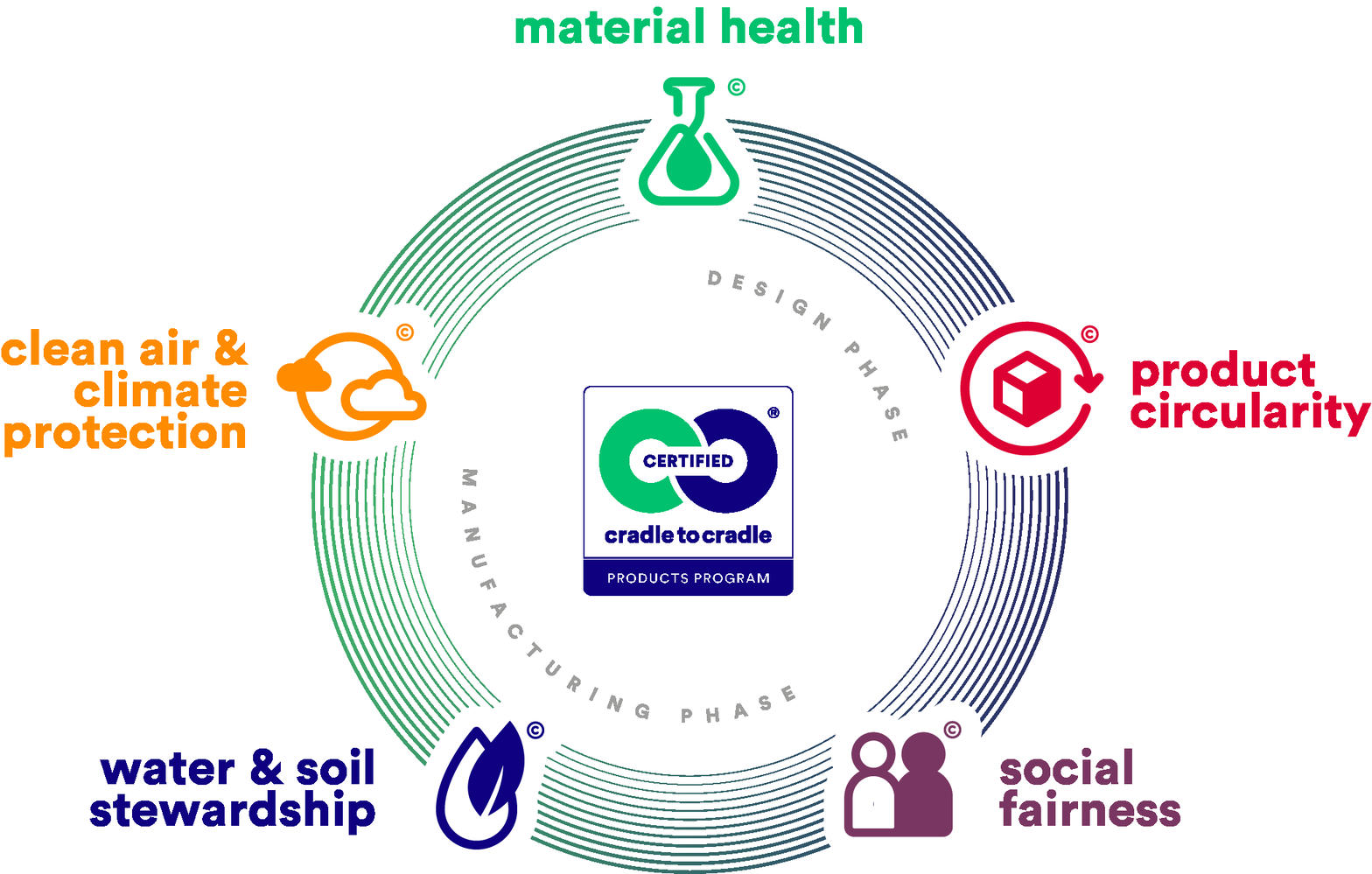
Cradle to Cradle Certified
Cradle to Cradle Certified is operated by the Cradle to Cradle Products Innovation Institute. The Product Standard (Full Scope), version 4.0, assesses materials and products across five categories: material health; product circularity; clean air and climate protection; water and soil stewardship; social fairness (C2CPII, n.d.a). Achievement levels are Bronze, Silver, Gold and Platinum (C2CPII, n.d.b). The Institute describes the programme as a Type I environmental label aligning with ISO 14020 and 14024. The overall level is limited by the lowest category score — a structural feature of the standard that a pack-level “C2C Gold” lock-up does not disclose unless the artwork says so. Packaging of a certified product is not automatically certified as a separate object; the standard’s public pages retrieved for this article did not yield a millimetre table, and none is stated. Logo use follows the licence issued with the certificate.
Empowered consumers
Directive (EU) 2024/825, applying from 27 September 2026, is the reason these marks have become more rather than less important on EU-facing packs. Sustainability labels must be based on a certification scheme meeting listed conditions, or established by public authorities. Recital 7 names the EU Ecolabel. Commission guidance treats national and regional ISO 14024 ecolabels — the Nordic Swan, Blue Angel family — as public-authority labels, and treats labels of non-EU public authorities as requiring a certification scheme (as set out in the self-declared-labels article). C2C, a private Institute scheme, travels through the certification-scheme gate, not the public-authority gate. A house “eco” flower that resembles the EU Ecolabel is the confusion Article 10 of Regulation (EC) No 66/2010 already forbids, now reinforced by the UCPD annex.
Traps
Ask which object was certified. A Type I mark on a pack is often a product mark. There is no EU Ecolabel product group for empty packaging as such. Blue Angel DE-UZ 217b is a paper-bag-and-box group, not a general packaging award. Nordic Swan 103 is liquid-food packaging, version-dated to 30 June 2028. C2C’s overall level is the lowest of five categories. “Type I” is deprecated ISO vocabulary still used by the schemes. None of these marks is a sorting instruction, a recycled-content mandate, or a substitute for Triman, OPRL or How2Recycle. No millimetre figures are stated where the cited public pages do not state them. Licensed flowers, swans and C2C lock-ups are not reconstructed as production files.
References
Blauer Engel (n.d.a) The German Ecolabel.. Available at: Open source (Accessed: 22 August 2026).
Blauer Engel (n.d.b) Paper bags and boxes made out of recycled paper (DE-UZ 217b).. Available at: Open source (Accessed: 22 August 2026).
Nordic Swan Ecolabel (n.d.a) The official Nordic ecolabel.. Available at: Open source (Accessed: 22 August 2026).
Nordic Swan Ecolabel (n.d.b) Packaging for liquid foods 103.. Available at: Open source (Accessed: 22 August 2026).
Cradle to Cradle Products Innovation Institute (n.d.a) The Standard.. Available at: Open source (Accessed: 22 August 2026).
Cradle to Cradle Products Innovation Institute (n.d.b) Get certified.. Available at: Open source (Accessed: 22 August 2026).
Regulation (EC) No 66/2010 of the European Parliament and of the Council of 25 November 2009 on the EU Ecolabel. OJ L 27, 30.1.2010.. Available at: Open source (Accessed: 22 August 2026).
Directive (EU) 2024/825 of the European Parliament and of the Council of 28 February 2024. OJ L, 2024/825, 6.3.2024.. Available at: Open source (Accessed: 22 August 2026).
Note on sources and verification
Blue Angel’s status as the German Federal Government ecolabel and UBA’s role are from the scheme home page; DE-UZ 217b feedstock rules and recovered-paper description are from the paper-bags-and-boxes product-world page. Nordic Swan’s Type I / ISO 14024 statement, Nordic Council origin, country list, GEN membership and liquid-food packaging minima, version and validity date are from the official-ecolabel page and criteria 103 page. C2C’s Type I / ISO alignment and five categories are from c2ccertified.org/the-standard; Bronze–Platinum levels and version 4.0 are from the get-certified page. EU Ecolabel packaging consequences follow the Theme 2 article, which rests on Regulation (EC) No 66/2010 and Directive (EU) 2024/825. EmpCo public-authority treatment of national Type I labels follows the self-declared-labels article’s reading of recital 7 and Commission guidance. ISO deprecation follows the ISO series article. No millimetre specifications were located on the cited scheme pages.
Last verified: 22 August 2026.