On this page
Home compostable: is the claim supported by evidence?
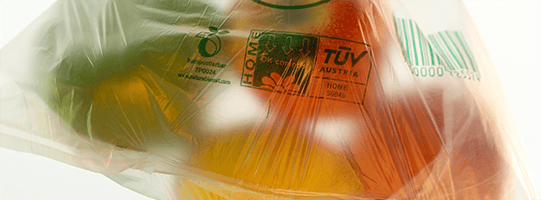
Marks and reference graphics are shown for identification, academic research and commentary. The image does not grant permission to apply a scheme mark to packaging; consult the issuing body's current eligibility and artwork rules.
Introduction
Home compostability is unusual because the certification appeared before a public standard. When Vinçotte created OK compost HOME, no standard for ambient-temperature compostability of packaging existed. The scheme wrote its own criteria; those criteria later became the reference others used.
That sequence is material because the claim the mark supports has since been the subject of a substantial empirical challenge. A citizen-science study of home compostable plastics conducted in the United Kingdom found that most of the materials tested failed to disintegrate in participants' compost heaps; the researcher leading the study characterised continued marketing of home compostables as "greenwash"; and regulators in Europe and the United States have subsequently narrowed or conditioned the circumstances in which the claim may be made.
What the claim asserts
Formally, home compostability is the more demanding counterpart of industrial compostability. Where the industrial standards test biodegradation and disintegration at sustained temperatures around 58 °C, the home schemes test at ambient temperatures, being the variable and low-energy conditions of a garden compost heap, over correspondingly longer permitted periods. The OK compost HOME scheme rules define the certification's boundaries expressly: the mark may be applied only to formally certified products, and it cannot support claims of biodegradation in soil or water, environments the certifier addresses through separate schemes (TÜV Austria, 2024).
The claim's regulatory framing in the United States runs through the Federal Trade Commission's Green Guides, which permit compostable claims only on "competent and reliable scientific evidence that all the materials in the item will break down into, or otherwise become part of, usable compost … in an appropriate composting facility, or in a home compost pile or device", and which require clear qualification where "the item cannot be composted safely or in a timely manner in a home compost pile or device" (16 CFR § 260.7). California goes further, permitting "home compostable" labeling only for products holding OK compost HOME certification, within a statutory scheme that also imposes fluorine limits and, from 2027, federal organic-input requirements (CalRecycle, n.d.).
The formal claim does not extend to the proposition that any given household's compost heap will process the item. The certification tests a material's capability under controlled ambient-condition protocols, whereas the conditions of an actual garden heap, comprising its temperature range, moisture, turning frequency and volume, fall outside the scope of any certification.
The evidence: the Big Compost Experiment
The principal empirical intervention was a citizen-science study conducted at scale. The Big Compost Experiment, run by a University College London team led by Mark Miodownik and reported in Frontiers in Sustainability in November 2022, enrolled some 9,700 UK participants, around 1,600 of whom conducted home composting experiments with plastics marketed as compostable (Frontiers, 2022; Packaging Insights, 2022).
Three findings organise the study's reception.
Performance: roughly 60 per cent of plastics certified or marketed as home compostable failed to fully disintegrate within six months in participants' real compost environments (Frontiers, 2022). Materials that satisfy laboratory ambient-condition protocols were therefore failing, at scale, in the class of environment the claim names.
Labeling integrity: the credentials of the packaging participants tested were mixed. 14 per cent of items carried industrial compostability certification only, and so fell outside the conditions for home composting, while 46 per cent carried no compostability certification at all (Packaging Insights, 2022). The home-compostable claim as encountered in commerce accordingly extends well beyond the certified universe the schemes administer.
Capability: the study estimated that only a minority of the population, on the order of one household in ten, maintains home composting capable of processing such materials effectively (Packaging Insights, 2022). On that estimate, even a material performing to specification would, in most households, encounter no functioning process.
Miodownik's stated conclusion was that if marketing of home compostables continues, "it's greenwash" (Packaging Insights, 2022). The study's limitations are material to the weight the findings bear: participants were self-selected, observations were self-reported, and the measured endpoint was disintegration rather than full biodegradation. Each of these limitations, however, operates in a direction favourable to the claim, since engaged citizen composters represent a more favourable population than households generally, and disintegration is the less demanding of the two endpoints used in the compostability standards. The observed failure rate was therefore recorded under conditions more favourable than average practice would present and against the easier of the two criteria.
The regulatory response
Regulation has moved in Europe and the United States in a consistent direction, away from the unqualified home-compostable claim.
In Europe, the packaging regulation's compostability provisions are constructed around industrial composting: the formats for which compostability becomes mandatory must be industrially compostable, and compostable packaging must be labelled as industrially compostable and warn against disposal in nature, a drafting choice that does not build on home compostability at all (Regulation (EU) 2025/40; Complydex, n.d.). European standardisation is consistent with that choice: the only EN-level home-compostability instrument, EN 17427, is confined to carrier bags, which is the single application in which dispersed low-volume composting has a defensible systems rationale.
In the United States, the FTC's home-qualification requirement (16 CFR § 260.7) renders the unqualified claim legally fragile wherever home performance cannot be substantiated, and the evidentiary burden of substantiation is heavier following the UCL findings. California's statutory scheme accepts the claim only on OK compost HOME certification, thereby binding US law to the European scheme's criteria (CalRecycle, n.d.).
The cumulative effect is a claim permitted in narrowing circumstances, on specified certifications, and subject to mandated qualifications.
The systems context
Beneath the evidential dispute lies a systems question that the structure of the home-compostable claim does not require its proponents to address, namely the rationale for routing packaging through dispersed household composting at all.
The candidate rationales are narrower than the claim's marketing indicates. Where compostable packaging's function is to carry food waste into collected organics streams, as with the caddy liner or with food-service serviceware processed together with its scrapings, industrial certification is the relevant instrument and home performance is not in point. Home compostability is relevant only where packaging will in practice remain at the household: the garden-adjacent formats, and the applications in which the alternative being avoided is a collection round. European standardisation is consistent with that division. The only EN-level home instrument, EN 17427, covers carrier bags, being the format jurisdictions deploy as organic-waste caddy liners, rather than home compostability generally, and the packaging regulation's compostability mandates are constructed entirely on the industrial route (Regulation (EU) 2025/40; Complydex, n.d.).
The systems frame also reorders the relative significance of the UCL findings. The 60 per cent disintegration failure has received the greater attention, whereas the capability result, namely that home composting adequate to the task exists in only a minority of households (Packaging Insights, 2022), bears more directly on the claim's general validity. A claim whose validity conditions include the infrastructure available to the person disposing of the item is familiar from the treatment of recyclability claims elsewhere in this theme; home compostability extends the difficulty, because the relevant infrastructure is a private garden practice that no scheme can measure, threshold or improve. Recyclability claims can be disciplined by access percentages, whereas there is no census of functioning compost heaps and therefore no analogue of "available to a substantial majority". That is consistent with the FTC's home-composting provision governing by qualification rather than by threshold (16 CFR § 260.7), and with the claim's resistance to the quantified governance applied to its industrial counterpart.
The research that would advance the question can be specified, and its absence is itself informative. A trial crossing certified materials with characterised real-world heap regimes, measuring biodegradation rather than disintegration, would convert the realism of the scheme criteria from an assumption into an estimate. The Big Compost Experiment's citizen-science design approximated the first half of that design; the second half, namely what fraction of certified-conformant material fully biodegrades across the distribution of actual household practice, has not been conducted. Until it is, the claim's proponents and its critics are arguing across an evidentiary gap that the certification system was not designed to close.
The scope of the certified mark
The position of the certified mark itself, such as the OK compost HOME seal on a certified film or pod, may be stated on two distinct readings.
On a strict reading, the mark remains what it has always been: an attestation that the specified formulation passed the scheme's ambient-condition protocols. Nothing in the UCL findings indicates that certified materials fail the scheme's own tests; the findings indicate a divergence between those tests and garden conditions. The mark's integrity as a conformity instrument is not in question on the evidence reported.
On a functional reading, the mark's communicative content has altered. A certification that predicts laboratory outcomes but not, for most users, real-world outcomes informs a choice whose outcome it cannot determine. A statement of the seal's content consistent with the evidence would be correspondingly conditional: that this material can be home composted, by the minority of households whose composting practice approximates the test conditions, over timescales that may exceed six months. The audience to which such a formulation applies is, on the study's capability estimate, a small proportion of households.
Three further limits complete the position. The mark does not license disposal in any environment other than a compost heap, and specifically not in soil, in water or as litter, since the scheme's own rules exclude those claims (TÜV Austria, 2024), and the biodegradability claims that would cover them are separately and more heavily contested, as this group's marine and soil article sets out. The mark does not imply acceptance in collected organics streams, where industrial certification and facility policy govern. Finally, within the uncertified population the UCL study identified, comprising the 46 per cent of tested items carrying no certification, the words "home compostable" on a package may attest to nothing that any scheme has verified, which is the situation general claims law exists to address.
Certification integrity and claim validity
The home-compostable case separates two propositions that are frequently conflated: that a certification has failed, and that a claim has failed.
Labels can mislead through several distinct mechanisms, and the diagnosis determines the available remedy. A mark can be fabricated, that is, printed without any certificate, which constitutes fraud and which the licensing machinery's traceability codes exist to expose. A mark can be misapplied, as where an industrial seal is read as a home-composting promise, which is a comprehension failure addressed by boundary rules and consumer information. A mark can drift, in that its visual form acquires connotations its criteria never contained, which is the pattern documented for the chasing arrows. Home compostability exhibits a fourth mechanism: every link in the formal chain holds, comprising a genuine certificate, genuine tests, criteria stated accurately and disciplined licensing, and the divergence occurs entirely in the inference from conformity to outcome. The UCL data did not identify licensees departing from the scheme; it identified a divergence between the protocol's model of a compost heap and the population of actual heaps.
This fourth mechanism is not reached by the standard governance instruments. Anti-fraud enforcement identifies no fraud; scheme audits identify conformity; comprehension research identifies consumers understanding the claim as worded. The divergence lies in the validation layer, that is, in whether the test predicts the outcome, and validation is the function that neither certifiers, which wrote the test, nor licensees, which passed it, nor regulators, which incorporated it, have a structural incentive to fund. In this instance the check was performed by citizen science financed outside the system.
The point generalises to other certified claims: where a certified claim's real-world truth depends on conditions the certificate does not measure, whether the available infrastructure, the facility's economics or the household's practice, the certification may be sound while the claim remains empirically unsupported. In the case of home compostability, both the question whether certification occurred and the question whether the certification predicts real-world performance have publicly available answers, and those answers diverge.
Summary
Home compostability distinguishes a well-administered certification from a well-founded claim. The scheme architecture, comprising criteria, testing, licensing and boundary policing, operates as the private-governance machinery described in this theme's marks article. What the evidence has undermined is the inference from certified capability to real-world outcome, and that inference has been tested publicly and quantitatively by a study enrolling some 9,700 participants, around 1,600 of whom composted marketed-compostable plastics (Frontiers, 2022; Packaging Insights, 2022). The claim continues to be permitted within the narrowing conditions that regulation leaves to it, and the sources examined here are consistent in the direction of their findings.
References
CalRecycle (n.d.) Truth in labeling for compostable products. Available at: Open source (Accessed: 18 August 2026).
Complydex (n.d.) PPWR labelling requirements: Article 12. Available at: Open source (Accessed: 18 August 2026).
Frontiers (2022) 60% of home compostable plastic doesn't fully break down, ending up in our soil, 3 November. Available at: Open source (Accessed: 18 August 2026).
Packaging Insights (2022) Home compostable plastics are ineffective "greenwashing scams", finds UK study. Available at: Open source (Accessed: 18 August 2026).
Regulation (EU) 2025/40 of the European Parliament and of the Council of 19 December 2024 on packaging and packaging waste, OJ L, 2025/40, 22.1.2025. Available at: Open source (Accessed: 18 August 2026).
TÜV Austria (n.d.) OK compost HOME. Available at: Open source (Accessed: 18 August 2026).
TÜV Austria (2024) CS-OK02: Certification scheme, OK compost HOME. Available at: Open source (Accessed: 18 August 2026).
16 CFR § 260.7 (Compostable claims). Available at: Open source (Accessed: 18 August 2026).
Note on sources and verification
The Big Compost Experiment's findings are cited from the Frontiers news summary of the study and from trade coverage; the underlying paper, published in Frontiers in Sustainability in November 2022 by the UCL team led by Miodownik, was not retrieved directly, and the author list is therefore not cited by name. The primary reference may be located via the Frontiers announcement cited. Participant and sub-sample figures (approximately 9,700 and 1,600) and the certification-mismatch percentages (14 per cent industrial-only; 46 per cent uncertified) are as reported in that coverage. The characterisation of EN 17427 as derived from the OK compost HOME criteria follows the certifier's own account. The estimate that only about one household in ten composts effectively is as reported in the study's coverage and should be treated as the study team's estimate rather than as a census figure.
Last verified: 18 August 2026.